30 Oct

2 Comments

Discovering the Wilds in a $400 Yacht

by

Autosave-File vom d-lab2/3 der AgfaPhoto GmbH

SCA EXCERPT FROM BUCKING THE TIDE
David Buckman

The flickering lantern spread a civil glow across the cabin as we had dinner, the depths of our tiredness washing over us. Clearing the bilges of the leaky 18-foot wooden sloop after settling into our sleeping bags, I left the pump propped up next to my pillow, its hose stuffed into the centerboard trunk. With this arrangement I could roll over in the middle of the night and evacuate the influx before the ever rising internal tides gave us the rudest of awakenings. “Remember Bucky,” the mate chortled seconds before snoring reverberated from his berth on the other side of the centerboard trunk, “The tide waiteth not upon the sloth of any man.”

Morning was burdened by a dull pewter sky, scarves of fog blowing low and the main halyard beating a tattoo against the mast. Tuning in a local station on the portable radio, the only piece of electronic gear aboard, the marine forecast started out with small craft warnings, calling for a 15-25 knot southwesterly. We were hoping for something more civil, decidedly more civil. There was a certain tension to our mood, that we tried to keep to ourselves, but every time the mast shuddered, the reality of the challenge was painted vividly across our minds.

That it would be a fair breeze once we cleared the Sakonnet River was the only comfort, and with an early start we hoped to put a few miles behind us before it matured to full force. We knew if we didn’t give it a try, we’d spend the rest of the day regretting it, and after studying all the escape options from Westport to Fairhaven, we shoved off for Marion, 41 miles to the east.

Bashing into a cauldron of steep sided seas, the little wooden sloop pitched over on her ear and bucked through the white crested slop. Slap. Slam, crunch the bow bit into every wave. Slacking off the wind a few degrees to minimize the pounding, which I feared would loosen every screw in her dodgy bottom, a steady stream of salty tears sluice aft.

Weathering the frenzy of whitewater bursting against Schulyer Ledge, our sense of deliverance was palpable as we bore off the wind and winged out sail. Ahead lay the plentifully periled waters of Buzzards Bay, a shallow 50-mile-long sound, contained on its southern flank by the broken chain of the Elizabeth Islands, and to the north by a low coast harboring the old whaling ports of Fairhaven and New Bedford.

As the ebbing tide turned its weight against the wind, growling seas heaped into frothy crests that toppled noisily alongside, and our lot was invested of a stirring spectacle. Hauling away at the centerboard pennant till she had little more than two feet of draft, eased the helm and gave her a more forgiving posture in case she flirted with a broach, which I’d witnessed a number of times on the race course.

Like a skier playing the rhythm of a mountain we banked our $400 cruiser off the crest on one wave, and swooped down the trough of the next with a rush of speed that set our stomachs to quivering. We worried that she might bury her bow in the backside of waves we were overtaking, but the sloop rose buoyantly to challenge after challenge.

Peering into the mists as we raced along there was a wildness to our lot beyond our most vivid imaginings, but no time for anything but paying attention to the Leight’s mood which was transmitted to us with commanding alacrity. Feeling like prey among predators I cast quick glances at the army of seas rolling up astern, and checked the backstay telltale to make sure we were square to the wind.

In the midst of it all the mate’s pallor began to take a turn for the worse. “Skip, I think I’m going to be sick,” he mumbled. His moment of extremis was exceedingly graphic. He felt better for it. I felt worse.

Not long after the mates returned to duty we were startled by a pale specter rising out of the water off the bow, and with our hearts thumping away like drum beats we struck the jib with the downhaul to slow our flight. The amorphous shape evolved into the hulk of a rusty old freighter impaled on Wilkes Ledge.

We discussed putting into Fairhaven, which was tempting as it was only a few miles to port, but without the confidence of experience these were uneasy calls that left us anxious. Hours passed, the mists grudgingly dissipated and not long after midday we washed into Sippican Harbor in as civil circumstances as could be imagined, for at this point in our life of adventure, any cruise we could walk away from was a good one.

Poking about the shallows by Tabor Academy we came to rest alongside a dinghy float at Barden’s Wharf and inquired about a berth for the night. When the dockmaster asked where we were laying, he did a double take when we pointed to the Leight. “Oh that,” he said flatly as though she were an unworthy trifle. “Stay right where you are, I won’t charge you for that.”

She might have been an unworthy trifle to him, but I saw many good things in her simple harmonies and felt affection, which seemed the optimal circumstance in which to pursue such things. —END

Signed copies of Bucking the Tide available here.
Filed Under: Uncategorized

30 Sep

5 Comments

Nominate Your Favorite Small-Boat Cruising Ground

by

FavoriteCruisingGrounds

There are lots of places to sail—especially in a small boat—but let’s face it, some places are better than others. Maybe it’s the amazing weather and consistent winds, or the scenery, or the miles of shallow water and deserted anchorages, or the special history of the place. Whatever brings you back, we’d like to know about it for a feature article we’re working on.

In the survey below we’ll ask you for a few details about your favorite spot and we might include your quotes and information in the upcoming feature. (We know we’ve already asked some of you this question and we appreciate your previous response and may use those too, but this more formal survey will help us flesh out the article—Eds)

Click here to participate in survey.

Thanks!

Filed Under: Uncategorized

13 Aug

0 Comments

The Cartop Carrier Yacht

by

GravesCartop
An Inveterate Tinkerer Turns Things Upside Down
by Jim Graves

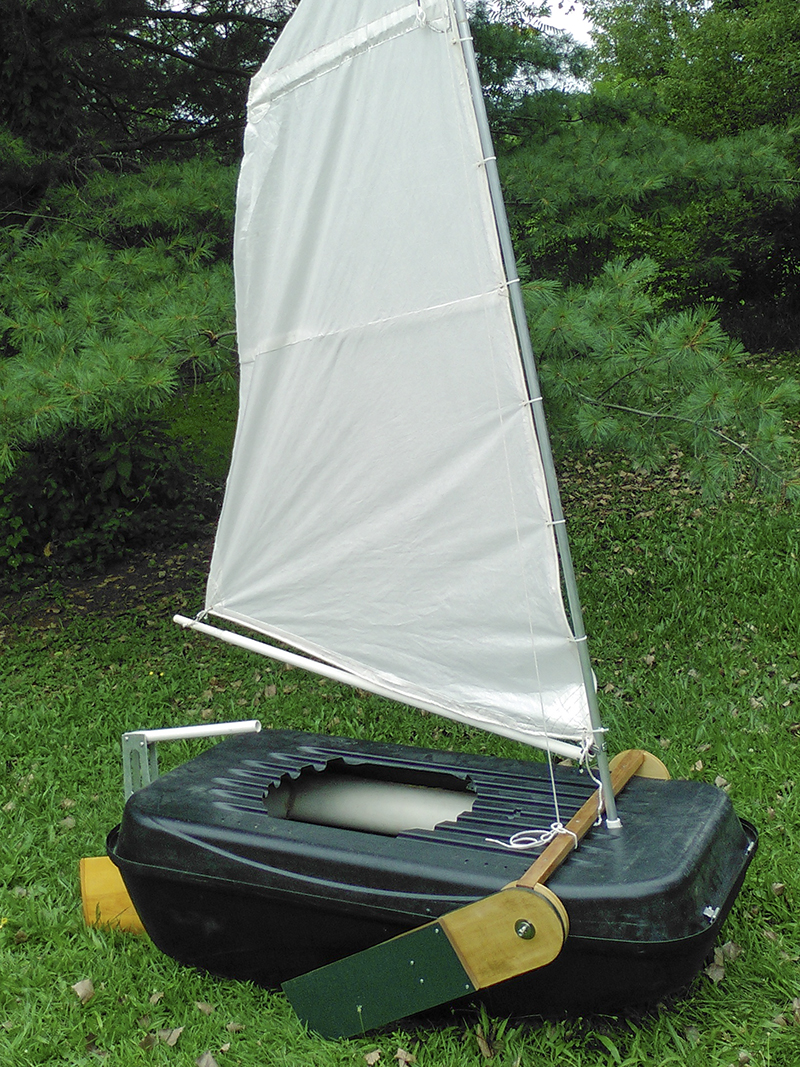
I stopped at a nearby neighbor’s almost perpetual garage sale, where a Sears cartop luggage carrier about six-feet long caught my eye. I figured that with a bit of work—some judicious cutting and drilling here and there—it’d make a quickly-built and quirky little sailboat.

After a bit of planing and sawing, the hull begain to show promise of a capable, if tiny, sailing craft. Much online research was begun to find the specific ratios and distance dimensions. A lot of small boat comparisons of apparent sail area to hull profile were tallied; the same with lee board size and location. The “quick” project went the same as all the others, taking far longer than expected, but the enjoyment was not diminished. It became obvious that, more than with motorcycles and other builds, a sailboat has to have all its component parts designed at the same time to work properly. As in an engine, everything has to work together, and small dimensions matter. It takes at least as long to research and design as to build and install. But the hope remained that, in the end, maybe it would float.

I also consulted with a few experienced and successful sailboat designers. I learned that the scale of the appendages does not change at the same rate as the hull, when scaling to a different length. So, as always, a bit of “over engineering” in places seemed wise, if specifics are not known. That is, we don’t have to know some of the exact parameters, but should be able to compare and copy closely. Thought was applied to where stress would originate and travel. Also, it was decided the materials used should be conducive to low-cost construction. Pine wood was settled on for its lightweight and finished beauty.

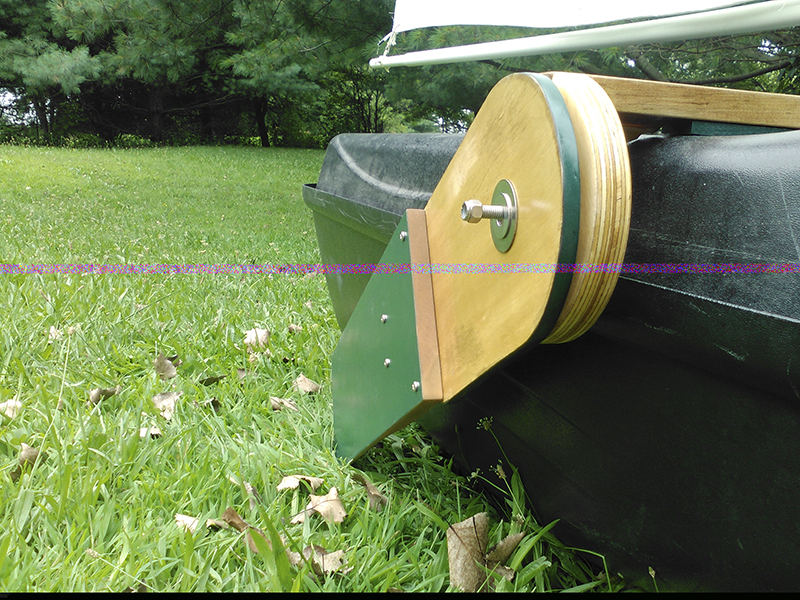
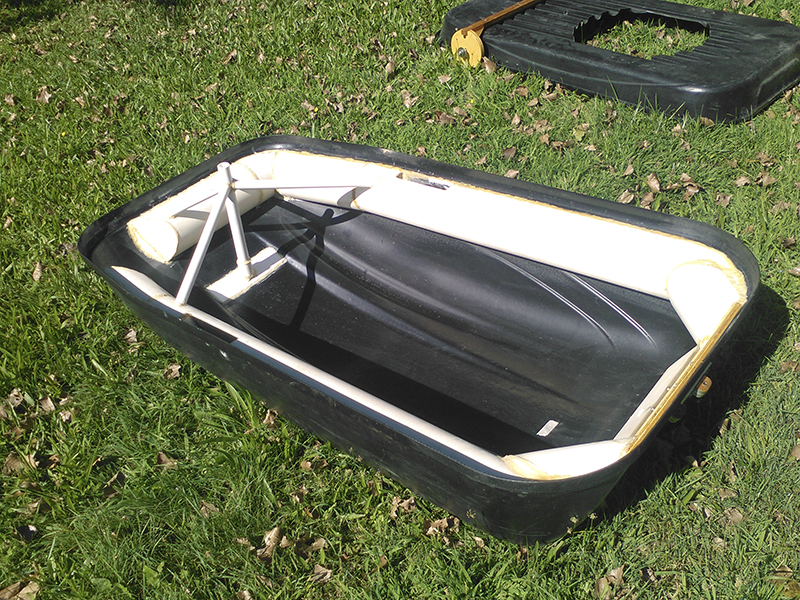
Some extra heft was put in the leeboard swivel surface. The hull was stiffened using 6″ pvc thinwall tubing around the upper inside gunnels. And it provides floatation. The mast step is pvc tube too, held stiff and distributing the loads by lateral tubes to the gunnels, with a stiffening plate under. More pvc space frame may be added later. If it floats. An aluminum extendable tube was attempted as mast, but added unneeded complication; the old proven aluminum tube being resorted to. The experimental  sail is of painters drop cloth. The boom will be changed from the pvc to matching aluminum. L-boards and rudder are foil shaped, and the rudderhead is hand carved, using electric power tools. Stand by in a future issue of Small Craft Advisor, for the results of the sea, I mean, pond, trials…. if it floats.

graves3b

The all-self-built assembly.

graves4

Showing lee board swivel mounting.

graves2

Inside. Flotation gap allows enough room for skipper’s nap below.

Filed Under: Uncategorized

27 Jul

2 Comments

Pocket Yacht Palooza and Crooza

by

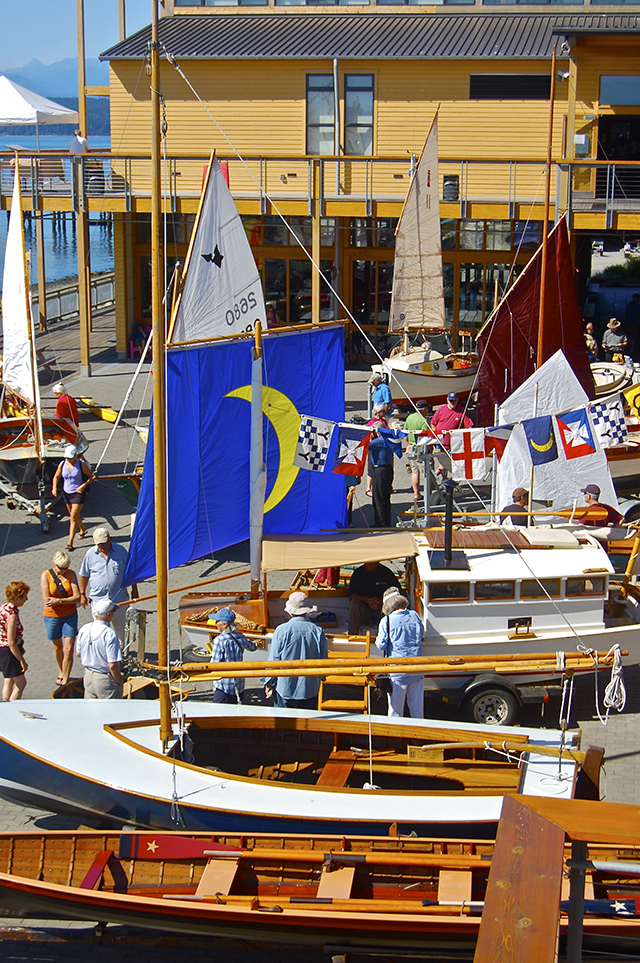
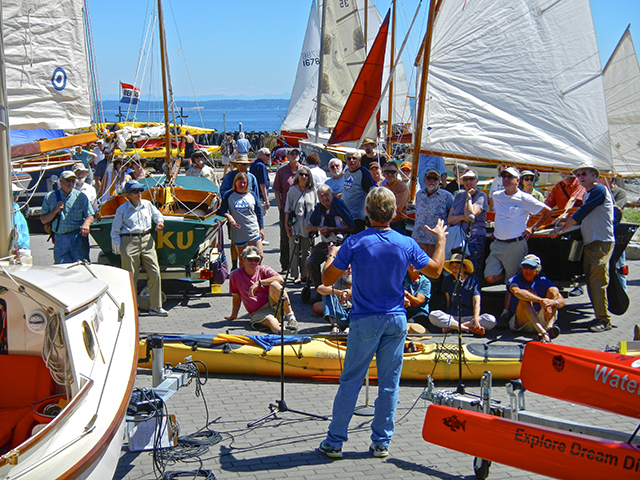
July 18th saw boats gather in Port Townsend for the fourth annual Pocket Yacht Palooza. In addition to the boats on trailers and along the waterfront, visitors were treated to a Q&A session with several Race to Alaska racers—including first solo finisher, Roger Mann. And that evening, small-boat designer John Welsford gave a stimulating talk on “Designing for Dreams,” which included his sharing details and photos of Howard Rice’s nearly finished modified adventure SCAMP and Howard’s plan to return and explore remote Tierra Del Fuego by small boat.

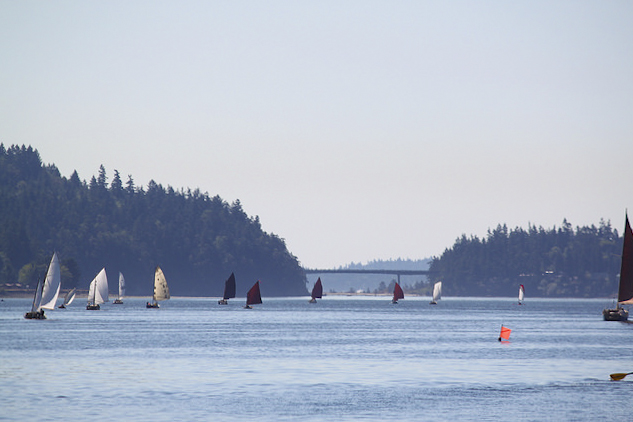
The next day more than 20 boats set off on the first ever Palooza Crooza, a scheduled 3-day cruise around nearby Marrowstone Island. What follows are photos from the festivities and cruise.

paloozaMarty1

Palooza in full swing. Photo by Marty Loken

RogeratPalooza

R2AK solo racer Roger Mann answers questions. Photo Marty Loken

fleetHelen

The fleet setting off for Mats Mats Bay. Photo Helen Leenhouts

CoreSound

Danny Grunbaum of Seattle with his twin 13-year-old twins, Sam and Maks aboard their Core Sound 17. Photo Helen Leenhouts

bellestar

Pete and Helen Leenhouts’ little tug called Blue Star. They served as escort the entire cruise. Photo Josh Colvin

charlesScamphelm

Charles Silver at the helm of SCAMP #1. Joel Bergen’s Navigator Ellie in background. Photo by Josh Colvin

DebraColvin_20150719_8272

Tom Gale’s Bolger Old Shoe passing under bridge at Port Townsend Canal. Photo Debra Colvin

pramparade

A pram parade of SCAMPs looking for wind. Photo Josh Colvin

IMG_1464

Rick Proctor took this shot of another San Francisco Pelican from his own Pelican.

opus

Lee’s Oughtred-designed Wee Seal called Opus. Photo Josh Colvin

OLYMPUS DIGITAL CAMERA

Tom Carr’s Mirror Offshore 19 called Bluebird. Photo Helen Leenhouts

DebraColvin_20150719_8327

Simeon’s SCAMP #11 Noddy headed under bridge. Photo Debra Colvin

lynn

Lynn Watson and Katie Mae ghost into Mats Mats Bay. Photo Josh Colvin

martyMats

A few of the boats moored at our gracious host’s private dock in Mats Mats. Photo Marty Loken

martyscene

Sunset on Mats Mats. Photo Marty Loken

19349866254_16be780de8_z

Kirk Gresham’s Crotch Island Pinky, and David Jones’ Oughtred Eun na Mara cruiser near Marrowstone Point. Photo Helen Leenhouts

19352140463_b62cf7bb58_z

Scott Marckx’s Welsford Rogue runs close to shore. Photo Helen Leenhouts.

palozacruisers

Palooza Croozers at the dock at Fort Flagler State Park. Photo Marty Loken

noddy

Some boats used beach rollers to overnight at Fort Flager. Photo Marty Loken

Marysleep

Palooza coordinator, Marty Loken, catching a well-deserved nap. (George Holmes designed canoe yawl based on the Ethel design) Photo Helen Leenhouts

Filed Under: Blog, General Posts