08 Jun

23 Comments

R2AK Rumors and other Informal Speculation

by

We’re into the second day of action since racers left Victoria and things are significantly more interesting.

As expected, the fleet, which was bunched up fairly tight heading in Haro Strait, splintered into many sub groupings as the cerebral part of the R2AK began and racers picked their courses.

Many of the bigger boats—including the leg-one-winning 38-foot catamaran of the Golden Oldies—chose to head outside to the wider part of the Strait of Georgia seeking more wind. This strategy appeared to backfire, as teams MOB Mentality, Hexagram 59, and Turnpoint Design found enough wind squeezing between the islands to rejoin the Strait with a good lead.

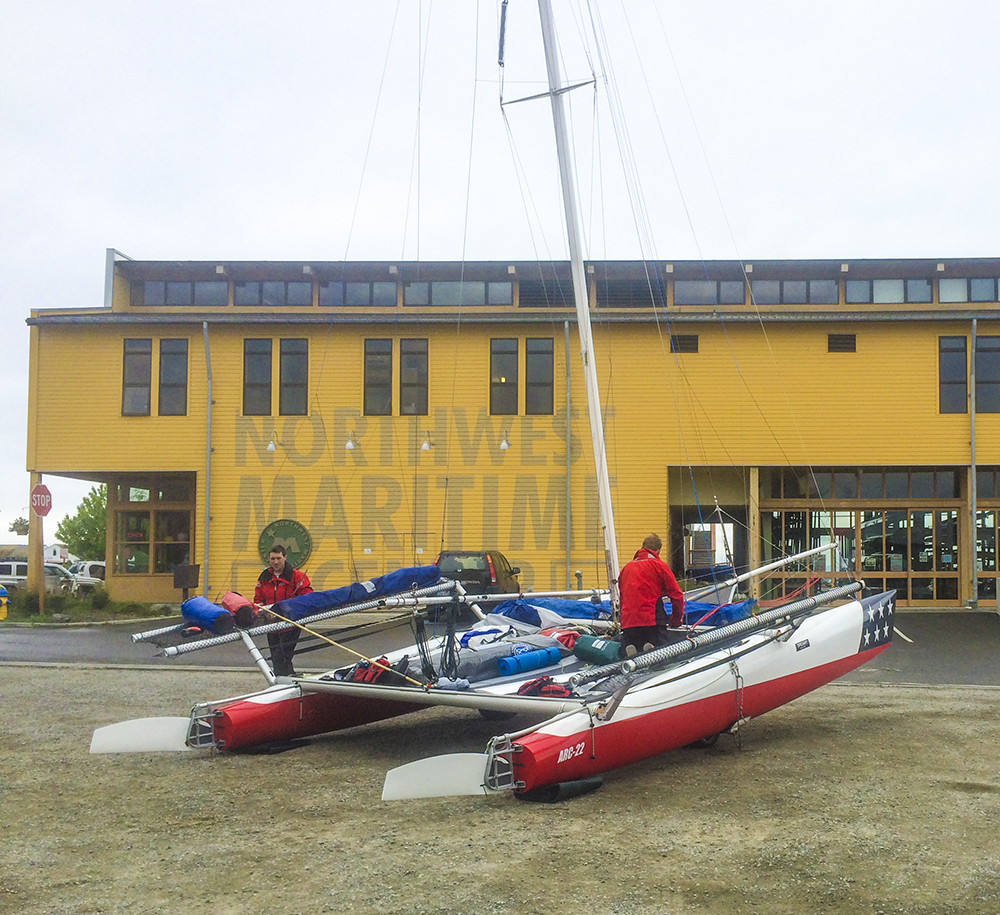
While many of the teams said before the race that they planned to sail through to Ketchikan with few or no stops, many are now likely feeling the harsh reality of the task before them. Early favorites Team Freeburd in their ARC 22 catamaran apparently sustained minor damage last night and have pulled into Nanaimo for repairs, and early challengers, Turnpoint Design in their just-launched carbon-fiber catamaran, have dropped out of the race because of technical problems. The last Spot Tracker showed them heading southeast toward Point Roberts.

Another new, untested design and early favorite, Team Pure and Wild’s performance proa was last seen suspiciously heading south at 7 knots themselves. It could be that adventure-race rule number one—“know your boat”—is inviolable here at the challenging Race to Alaska.

Team Real Thing (L-7 Trimaran) dismasted this morning at 8:20 am. They are reportedly safe and sailing under jury rig to Galiano Island, but have withdrawn from race.
realthing
Team Real Thing pictured above

The latest tracker view shows the highly skilled crew of Team Elsie Piddock’s F-25c trimaran with a nice lead heading north near Denman Island. The real question is whether they’re moving fast enough to sneak through a tidal window at Seymour Narrows that their competitors miss. If not, all of their hard work sailing through last night might be for naught as the “slinky effect” comes into play and slower racers catch up while they all await a favorable current.

Filed Under: Uncategorized

Tags: ,

01 Jun

2 Comments

Race Day Approaches (R2AK)

by

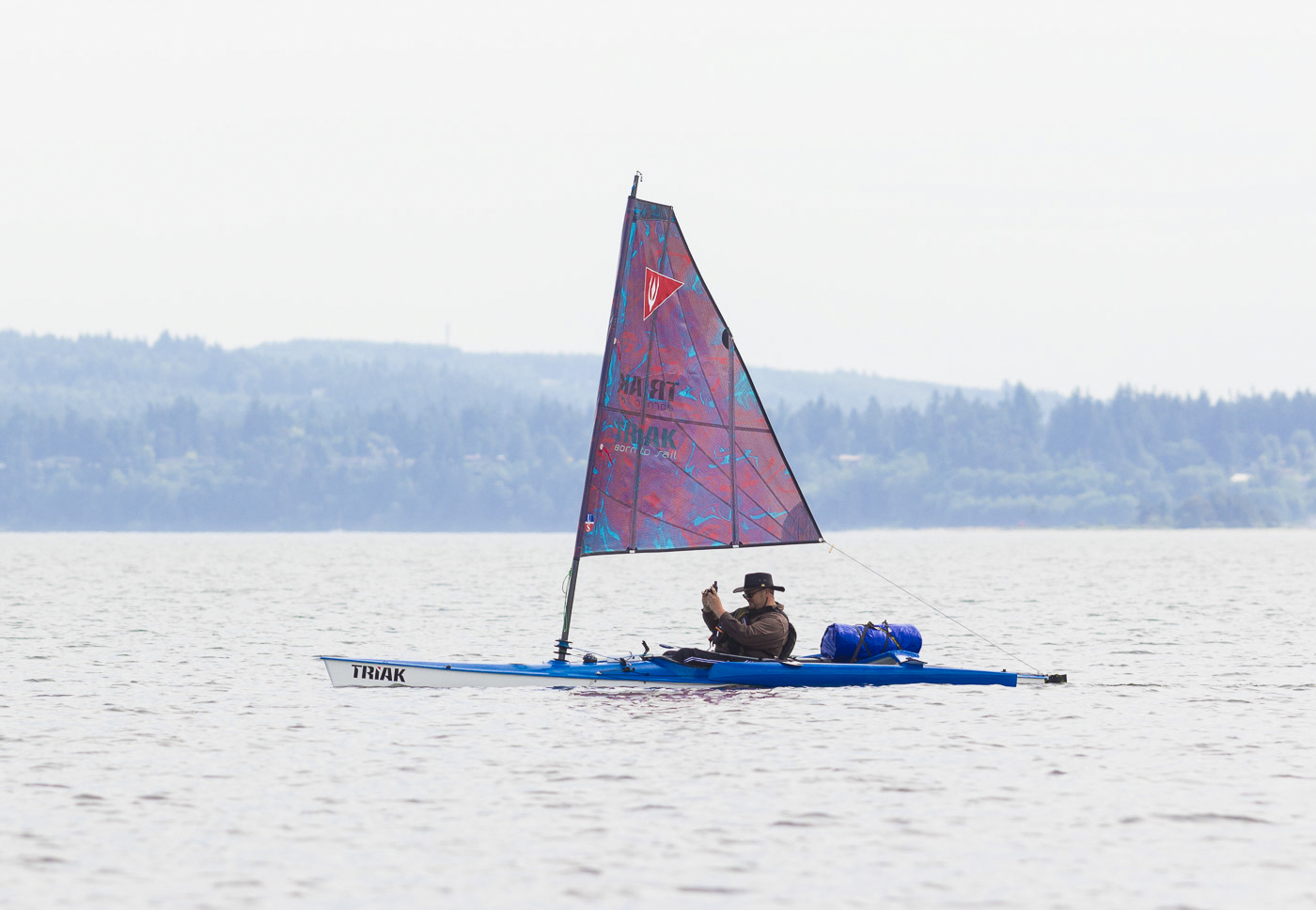
Triakr2akThings are abuzz here in Port Townsend as the start of the first ever Race To Alaska draws near. Sailors and crew of various boats can been seen around town already, tuning and tweaking (or trying to finish) their boats in preparation for the Thursday morning departure. Other hearty crews are sailing across the Strait just to get to the starting line.

Given this is the first ever race of its kind, being held at a time of year when wind and weather are notoriously unpredictable, it’s hard to pick who the favorites are to win the $10,000 prize.

When we first proposed the idea of an engineless race from Port Townsend up the Inside Passage to Ketchikan, a number of expert sailors contended the race would certainly be won by a rowboat, with the fickle winds leaving the sailboats to wallow and wait. It’s true, most of the reports we’ve heard from sailors making the same passage describe little or no wind and many days at the oars.

But now, three days before the horn sounds, the general consensus is that the big multihulls are the strong favorites. Sure, they’ll be difficult to propel consistently with sweeps or pedal drives, but in any kind of breeze they’ll be sailing, and with larger crews and more creature comforts they’ll think nothing of sailing straight on through 24 hours a day and “going outside”—at least once they’ve cleared the mandatory checkpoints in the narrow sections—to find even more consistent wind.

One of the many fascinating subplots—especially for us small-boat fans—is to see whether the versatility and manageability of some of the little boats will provide enough of an advantage for them to challenge. In particular, whether the little boats can establish a lead in the spotty winds and tidal area between Victoria and the north end of Vancouver Island.

Here are a few more things we’ll be watching closely:

• Shakedown or Breakdown: The 40-mile first leg from Port Townsend to Victoria is really just a qualifier and will have no bearing on who wins the race ultimately, but it’s also one of the more potentially challenging stretches along the 750-mile course. With current forecasts predicting up to 20 knots race-day afternoon, the Strait of Juan De Fuca could certainly weed out a few of the fleet.

• Speed and Stamina: There are some big multihulls in this race, but the hull-speed relationship between smaller and bigger monohulls does not apply to the multihulls. Can the crews of the smaller beach cats endure exposure and additional hardship to keep pace with the larger multis?

• Will anyone take advantage of the portage option? R2AK rules allow portaging your boat so long as no other vehicle—not even a bike—is used to assist. Looking at the route it seems unlikely, but could a team with a lightweight boat find a way to exploit the rule to advantage?

• Wild Cards: Handicapping this race is almost impossible, but one thing is for sure—in a few days or weeks we’re going to know a lot more about which boats and strategies worked and which didn’t. How about team Pure and Wild’s custom-designed proa? This very serious contender might be the fastest boat in the field, but the sleek Polynesian design also looks a little vulnerable. Given the rugged nature of the course, are they bringing a stock Ferrari to a rally race?

And what about adventurer Graham Henry and his Soggy Beavers team in their six-person OC-6 outrigger canoe with sail rig? Certainly so much manpower is an advantage when paddling through the calms, and they should be able to keep each other motivated. On the other hand, that’s a lot of gear to bring along and sleeping in a seated position will get old fast.

• Ye Olde Pedal Drive: How many sailboats have you been aboard that use pedal drives for auxiliary propulsion? That’s what we thought. Yet it looks like nearly half the R2AK fleet will be sporting them—some purchased off the shelf and others custom fabricated. Pedal drives are always finicky and often fragile, so we’re skeptical they’ll be a reliable option at this distance if winds are light. Better pack the oars just in case.

• Superhero Underdog: It tells you something about the quality of the racers in the R2AK (world record holders, Olympians, etc.) when you consider that National Geographic Adventurer of the Year, Colin Angus and his pull-up exercise champion crew, Steve Price, are one of sleeper picks to win the race. Even if they are somehow able to row and sail day and night without stopping, will their little 150 pound boat be fast enough to keep up with the ultra-fast race boats and Goliath multihulls?

• The Slinky Effect: Seymour Narrows (northern inside part of Vancouver Island) tidal current runs at up to 16 knots, switching directions without almost no slack at specific times each day. Engineless R2Akers will be forced to wait for favorable conditions before attempting to transit. Even in less challenging narrow sections the fastest boats will struggle to go anywhere against a strong foul current. As a result, faster boats who race ahead are likely to be caught by slower boats as they sit waiting for a window. Boats who can plan to catch the last of a fair current just as they arrive at tidal passages might gain half a day or more on those who miss it.

• Additional Firsts: We’ll all be excited to hear who wins the race, but just as interesting might be the competition for other “firsts”: First monohull, first solo racer, first rowing boat, smallest boat to finish, etc. And because it’s the first year, there will be a slew of records established.

Whatever happens, it will be fun to follow the action!

More information:

Fifty-six teams will depart Port Townsend, Washington, this Thursday, June 4, at 5 am, heading for Victoria, BC in Stage 1 of the inaugural Race to Alaska (R2AK), a unique, non-motorized, 750-mile marathon geared toward long distance rowers, paddlers and sailors.   
 
The race departs Port Townsend, Washington on June 4, and finishes in Ketchikan, Alaska whenever the first finisher arrives; estimated to be 7-10 days after the start.  The first person or team to finish wins $10,000.  Second place will be awarded a set of steak knives. There are 36 teams registered to do the full race, with 20 additional teams registered to complete the Port Townsend to Victoria leg.  Teams hail from all over the US and Canada. The race is being hosted by the Northwest Maritime Center. 

For more information visit: http://r2ak.com/

Team bios available at http://r2ak.com/registered-participants/
nwmcr2ak

Roger

27 Apr

7 Comments

No Adventure Too Small

by

morro

by Joshua Colvin

The concept isn’t particularly new—especially not to Small Craft Advisor readers—but the more general outdoors crowd is beginning to figure out you don’t need to trek to the Himalayas or row across the Atlantic to have a satisfying, challenging experience in nature. More would-be adventurers, it seems, are recognizing that with the demands of work, family and other responsibilities, they may never find the time and money to schedule that grand expedition. Magazines and blogs are buzzing about so-called “micro adventures,” short, thrilling trips that fit in around work and family commitments.

Author and adventurer, Alastair Humphreys, is the most prominent voice of the microadventure movement. On his blog he offers five bullet-pointed reasons to live more adventurously:

• To experience the wild and escape from the rushed, mundane real world.
• To do something new, fun and different.
• To spend memorable time with your friends, family or by yourself.
• To challenge yourself, surprise yourself, and achieve something to be proud of.

The fifth is, of course, to put into practice the fun suggestions you’ve seen in his best-selling microadventures book.

Some of Humphreys’ microadventure suggestions include:

• Sleep in your garden.
• Swim wild—in a river, lake or sea
• Sleep under a full moon
• Forage for your food, or at least pick some blackberries
• Learn to identify a new bird or new tree each month

The list of possible microadventures is limited only by your imagination, but it occurred to me that our small boats are like microadventure magic carpets—perfectly facilitating our desires to be out in nature exploring, escaping, or challenging ourselves. How quickly we could make our own list:

• Sleep aboard your boat
• Sleep in your cockpit under a full moon—heck, even in your driveway!
• Row or sail to that shore or island and forage for food or pick berries
• Beach your boat in that tidal creek down the road and stay overnight
• Carry that dinghy, inflatable, or kayak to a nearby mountain lake or pond and be maybe be the first to explore it by boat

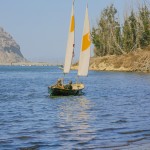
I’ve been thinking a lot lately about using our small boats to their best advantage. In fact I write about the topic and a recent shallow-water cruise in the coming issue (#94). I think we small-boat sailors sometimes have a hard time seeing the forest for the trees, or the estuaries for the bays, if you will. I remember when I sailed California’s Morro Bay being determined to push myself and my small boats by venturing out of the harbor mouth and into the open Pacific. I’d sometimes sail out and away from shore and then realize there wasn’t much to see or do. Now what?

Meanwhile the scenic, protected back bay—a tortuous maze of shallow channels and tidal currents—was teeming with marine life and just begging to be explored by a shallow draft boat. Today I regret I didn’t spend more of my sailing time back there solving my own little Riddle of the Sands and beach-camping the dunes.

Here in Port Townsend it’s a similar story, as nearby islands, bays and creeks offer endless opportunities for micro-adventuring, yet so many sailors race off under outboard power toward the San Juan Islands for a rushed, sometimes stressful few days of cruising. It’s good to stretch sometimes, but we shouldn’t forget that with a small enough boat, we don’t need a lot of time, money, or energy to have remarkable experiences.

What kinds of small-boat microadventure possibilities do you have near you? Leave a comment and let us know—maybe we’ll see you out there.

Filed Under: Blog, Uncategorized

25 Mar

2 Comments

From “A Cruise in the North Sea” by Albert Strange

by

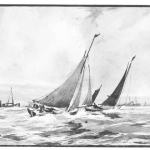
I hailed one of them to ask for the position of the Sunk Sand Buoy, which I could not pick up owing to the lowness of CHERUB’s side and the height of the sea, which had grown very much during the last hour. A man popped his head above the smack’s bulwarks, and, instead of replying to my inquiry, asked me what the ‘Hades’ I was doing off there in a little thing like that; and when I told him I was bound for Blakeney he grew almost angry, and tried to persuade me to run for Lynn, whither he was bound after he had made his haul. “‘Tis no place for any man to go for in weather like this, isn’t Blakeney. You come along arter me!” But I wanted to be in Blakeney, not at Lynn, and after he had told me that the Sunk Buoy had broken adrift, but that I was alright for the ‘Bays,’ I waved him farewell and left him in a sort of angry sorrow at my pigheadedness.

Along through the ‘Bays,’ which is a channel inside the Woolpack Sand, we had much less sea, though the wind kept freshening in squalls. The boat reached along beautifully — easy and dry — and I took the chance to get some food, especially as I felt rather downhearted after the fisherman’s warning, and I always find that things look ‘rosier’ on a full stomach than on an empty one. We were now dead to leeward, and when off Brancaster I pulled down the third reef, because I knew what awaited us when we should have cleared the Woolpack and be at the mercy of the full fetch of the sea across the Well. I had lost my proper account of the tides, and had no desire to get to Blakeney too soon. But there was no holding the boat; the full ebb seemed to be still with me, and the miles sped away astern very quickly, and early in the afternoon I was off Blakeney, much too far inside the Bar Buoy, and with a young flood tearing up towards the channel bearing me fast to leeward. It was now blowing very hard, and the surf to leeward making the air misty, everything looked as if at least an hour’s wait outside was imperative if we were to get inside safely. But, with the staggering sea and the strong lee-going tide steadily sucking me ashore, the boat made nothing at all to windward, and would certainly bear no more sail in the broken sea that was there.

I tried her on both tacks, but lost ground each time, and things looked very black. So, with my heart in my mouth, I pulled up the centreplate and pointed for the place where, amidst all the breakers, there seemed to be most water. On she ran, past the first outer buoy, then the second, and then, as she sank in the hollow of a sea — bang! she touched, and a walloping sea burst over her stern. But in bursting some of it lifted her along, and, as well as I could, I crawled forward and managed to keep her from broaching to with a long, strong boathook, when she touched aft again. The same business was repeated, but I felt that only a few more doses would fill her, and our last cruise would have been finished. Still, the strong flood tide kept her square to the sea, as she only hung on her keel, and after one or two more hard knocks she went over the Bar into smoother and deeper water, and, intensely thankful to the kindly powers that had preserved us, I ran her into the Pit, let go the anchor, and looked below. The water was just up to the floorboards, but the bed, stowed under the foredeck, was untouched, and the stove in its locker was dry and ready for action.

I have always felt that I owed my escape to the fact that the boat’s greatest draught of water was right aft, and also to the strong (six knot) tide that had held her straight. With a level keel or more draught amidships she would certainly have broached to and been rolled over by the tide and sea, and, as Blakeney Bar is miles away from all living beings, there was but faint hope of rescue, though the lifebuoy I had ready might have floated me to the sands, from which I could hardly hope to escape unless someone had seen us coming in, which I afterwards heard was not the case.

So, after returning the water to its proper place outside, I rested, refreshed myself with hot drinks, and waited for the tide to rise sufficiently to enable me to get to the quay, which would not be before dusk.

Filed Under: Blog, Uncategorized