STORY BY PAUL GUAJARDO
“Coast Guard Searches for Missing Sailboat: Houston—The Coast Guard began searching for a missing sailboat with one adult and two children on board this evening near Double Bayou, in upper Galveston Bay. A Coast Guard Sector Houston/Galveston watch-stander received a call from a sailing partner at 7:08 p.m. reporting the 21-foot sailboat had not arrived at the scheduled rendezvous and that he had lost contact with the sailboat around 4 p.m. Coast Guard Air Station Houston has launched an HH-65-C Dolphin helicopter to search for the missing sailboat. The people on board were planning a sailing trip from Clear Lake to Double Bayou, an 18-mile transit.”
It’s not every birthday that you make the evening news. All I wanted was a peaceful cruise with my boys on my birthday boat, but what I got instead was a bouncy bash to windward, a broken motor bracket, a submerged motor, a Coast Guard helicopter search, and a near-miss by an alligator.
But let’s start at the beginning. For two decades I’ve been an ardent fan of the cat-ketch rig. I’ve owned three Sea Pearls, including a trimaran. For a few years, we owned a Beachcomber 25 cat-ketch. And once, I flew my family to the Virgin Islands where we bought a Freedom 33, with free-standing carbon-fiber masts, and then slowly sailed home savoring stops in Puerto Rico, the Dominican Republic, the Turks and Caicos, the Bahamas, the Florida Keys, and the Louisiana swamps.
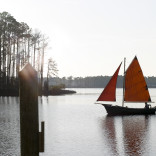
The cat-ketch rig has been around for more than a hundred years, and the Sea Pearl is loosely based on an old design by L. Francis Herreshoff. Halsey Herreshoff has also designed several boats with this unique rig. The Sea Pearl weighs a scant 600 pounds, but water ballast adds an additional 400 pounds, or so. Reminiscent of a whale boat, the Sea Pearl is double ended and just 5’ 6” wide with a draft of 6”—with the leeboards up. With the canvas cover over the center cockpit, there is just enough space for a chummy couple to sleep snugly.
Despite crowded quarters, Sea Pearls have made some intrepid voyages. Readers of Small Craft Advisor are well aware of Ginny and Steve Ladd’s voyage to Argentina. And back in 1986, 16 year-old Shane St. Claire sailed 5000 miles on a Sea Pearl from Tarpon Springs, Florida (where the boats are built) along the east coast, up the Hudson River, across the Erie Canal to the Great Lakes, down the Mississippi and back to Florida. The six month voyage was accomplished on roughly ten dollars per day.
I remember well, trying to talk my wife into letting me purchase my first Sea Pearl 21.
“Hey Lora, there’s a great deal on a cute little cat-ketch.” My voice cracks a little.
“You already have too many boats. You certainly don’t need another,” she says firmly.
“Come look at how cute she is.”
“How about I surf the web, and you cook dinner?”
“Just take a quick peek. She’s got a navy hull and yellow sails.”
“How many sailboats do you need? You’ve got one in the garage, one in the backyard, one in mini-storage, and one at the marina.”
Don’t you hate that kind of logic? But I wasn’t too proud to beg. I walked over to where she was scrubbing a dirty pot in the sink. I begin rubbing her neck, and then I bring out my piece de resistance: “But baby-doll, my birthday is coming up; I’ve just gotten paid for teaching summer school; these boats are really rare in south Texas, and you know I’ve always wanted one.”
I rub her shoulders, and she doesn’t immediately answer me, which means she’s thinking, which means there’s a smidgen of hope.
“Where would you keep her,” she asks.
“Details, details. Look at the big picture: fun in the sun, fresh air, fresh fish. The boys will love sailing her.”
“Why don’t you just sail the boats you already have?”
This woman should have been a logician. But I know she’s giving in, or at least considering my scheme. To her everlasting credit, and with only a little more groveling and begging, she relents. She even admits that the boat is mighty handsome.
As soon as I bring home my birthday boat, I begin planning a little bash aboard. Since the Sea Pearl is a bit small, I decided to take a long weekend with my two oldest boys, William and Henry, who at the time are 13 and 11. But the boat doesn’t come with a motor, and I can’t find a suitable used motor for sale, so against my better judgment, I ask my buddy Bill, if I can borrow his little 5 h.p. kicker. “Sure, no problem,” he says.
The boys and I get out the charts, and we plan our escape: we’ll launch in Clear Lake, near Houston, sail across Galveston Bay to Double Bayou. We’ll spend the night there, and then sail up the Trinity River to Anahuac where we’ll attend the annual alligator festival—which takes place during the short hunting season in September. We’ll spend a day or two there and then sail our handsome little vessel home.
Meanwhile, Bill decides that he’ll take his 35’ centerboard sloop and rendezvous with us at Double Bayou. The boys and I cram our gear aboard the blue-hulled beauty, and we leave on a Thursday morning. I tell my wife not to expect us until Sunday, and I mention that we will most likely be out of cell-phone range.
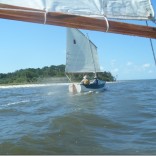
We have great expectations as we sail off. The ketch rig balances nicely, and I can let go of the tiller for long stretches of time. We easily hit five knots on a reach. But as the wind veers toward our nose, we soon lose sight of Bill’s much larger boat.
The wind picks up and soon we’re beating into choppy waves that send salty spray back to the cockpit. The Sea Pearl is responsive and stable, and we’re enjoying ourselves. But close-hauled, we’re barely making four knots. Eventually we have to reef both sails a bit, which is simply done by rolling the sails around the masts. We take pictures and reminisce about past sailing adventures.
William and I take turns at the tiller; Henry doles out snacks, monitors the GPS, and keeps us apprised of our speed and heading. By the time we approach the entrance to Double Bayou, the sun is setting into a colorful cloud bank, and I’m eager to get situated before the vampire mosquitoes emerge for blood. We motor up the bayou a bit, then nose into a small creek where William tosses our three pound fortress anchor off the bow. Once out of the way of water traffic, I try calling Bill on the cell phone, but there’s no reception. I hail him with the handheld VHF, but no response.
We set about to warm our three cans of soup which we eat with a bag of chips. Dessert is a handful of peanut M&Ms. I call Bill again, but still no response. I figure we’ll find him in the morning. A few minutes later I hear the thump-thump of an approaching diesel engine, perhaps a shrimper, but then I realize that the noise is overhead, a helicopter. That’s odd. I think, why are they flying so low? I have an uneasy feeling. Could Bill have called the Coast Guard on us? Well, if he did, we’re right where we said we’d be; surely the chopper saw us in the twilight, right?
The original plan is for the boys to sleep in the cockpit with a mosquito net. I make myself a little nest down below and turn in. Just as I’m finally falling asleep, I hear the boys mumbling. It’s raining—so much for the favorable forecast. We laugh about our situation: three of us crowded into the space of Queequeg’s coffin.
In the morning after our breakfast of instant oatmeal and a banana, we motor up the Bayou to find our friend Bill, but a fter a few miles we don’t see him. We try hailing him again, but no answer. Oh well. (We later learn that he had motored all the way up the bayou). We decide to sail on over to Anahuac and see how many dead ‘gators have been brought in.
We reach along at a good clip. Henry trolls a line for lunch. We motor-sail up the Trinity River. As we approach Anahuac, my cell phone finally finds a signal. I have two voice mails from the Coast Guard! They say that I have been reported missing and to please call as soon as possible. Oh-oh. I call immediately and state that we’re fine. Later, I learn that we were featured on the evening news and in the Houston Chronicle.
Unbeknownst to us, the Coast Guard called Lora—asking if she’s heard from us. She says no, but that she doesn’t expect to. The Coasties say they’re sending out a helicopter. Lora tells them not to. She says were fine, just out of cell phone range. She isn’t worried: Galveston Bay is barely 8 feet deep; there are no storms, and we’re experienced sailors. The official on the phone says, “You may not be worried about him, but we are.” They call every few hours. She begins doubting her instincts and passes a miserably sleepless night worrying.
It’s drizzling as we approached the ‘Gator Fest, so we decided to tie up at the little municipal marina where we take shelter from the rain and cook up some Ramen noodles. Two hours later when the rain stops, we head to the festival. As I turn the tiller, the motor bracket breaks, and the borrowed outboard sinks to the bottom of the drink. Oh-oh! The boys and I look guiltily at each other. There we are on a windless river without a motor. I learn later, from Marine Concepts, that the outboard bracket is rated for just 3.5 hp.
My first thought is that I owe Bill a new motor. My second thought is that it will be difficult to sail home without gasoline propulsion to make it through the Kemah cut, especially if the current is against us. My third thought is that I want that motor. I know I can make it run, and I can certainly use it on one of my many boats.
We paddle back to where we think the motor sunk. I pull on my swim trunks and jump in. The water is pleasant, but when I dive down ten feet, it’s cold and as murky as sludge. I can see nothing, but I feel around for the 5 h.p. Nissan. On each dive, I have to equalize the pressure in my ears. We aren’t exactly sure where the motor fell in, so I have a big area to search.
Mind you, I’ve been to the ‘gator festival before, and I’ve seen the jagged teeth on some of those 10’ long reptiles. As I glide along, feeling around with my hands like a blind man, I run smack into something big basking on the bottom. I’m sure it’s an angry alligator, but thankfully it’s a just a log. As I tread water trying to clear my eyes and nose, I hear fishermen on the bank yelling at me, and then I see a very ugly sight—an alligator, longer than me, heading over to investigate if that’s lunch splashing around.
I don’t remember exactly how I climb back into the boat without a ladder, but I do it very rapidly. The big bad ‘gator swims a sweeping curve, and then heads for the reeds near shore. There’s no way I’m getting back in the water, but I also hate the thought of leaving a $1000 motor submerged. I decide to call Lora to come get us. I’ll come back with my inflatable dinghy some long poles to feel around with, and a big magnet with which to pull up the motor.
Meanwhile, we have to get to the launch ramp, a few miles up-river. I paddle on one side, while the boys take turns paddling on the other side, and though it’s hard work, we’re in good spirits and joke along the way. I’m confident I can find the motor, but as we paddle up stream, I noticed a big sign that warns: “NO SWIMMING – Gator Infested Waters!”
Lora drives all the way around Galveston Bay and meets us at the launch ramp. We hurry home to get our dinghy with a 15 h.p. outboard. The boys and I return to the approximate place, and set a long PVC pole in the water to serve as a reference point, and with the other poles, we sound around on the bottom hoping to feel the motor, but no luck. We try the magnet, rated to lift 200 pounds, but again, nothing. It’s getting dark, and the boys are discouraged. As we motor back to the car, William holds a flashlight so other boats can see us. As we near the launch ramp, Parks and Wildlife officials wave us over.
“You don’t have running lights! May I see your registration?”
The last thing I need is a ticket on top of everything else. I hand over the registration card and try to explain. “We sailed over from Clear Lake yesterday, and our motor fell in the water. We’ve been trying to retrieve it. That’s why we have these long poles and magnet. We’re not out joy riding in the dark.”
“Are you the ones the Coast Guard was searching for?”
“Yes sir, that’s us. Our friend got worried and reported us missing.”
“Well, I imagine you’ve had enough trouble for one weekend. But you really need lights if you’re going to be running at night. There’s a lot of river traffic this weekend.”
“Yes sir. We understand.” To his credit, he waved us off with a, “Be careful.”
The next morning, the boys decide they’ve had enough fun for one weekend, so Lora and I drive back to Anahuac where we again launch the inflatable, determined to fetch the submerged motor. Before diving in, I carefully scan for alligators that might be skulking around. I tell Lora to keep careful watch. With a scuba tank, I’m sure I can quickly search a large area and easily find the motor. But in the coffee-colored water, I quickly become completely disoriented. As I grope around losing hope, I think, this is no way to spend a birthday. My air tank is almost empty, and I’m about ready to admit defeat, but decide to do one more dive. By this time, I’ve given up any attempt at a rational search pattern. I just dive and feel around blindly.
And then, there it is. I pick it up and try to surface, but the motor is too heavy. I get a rope from the inflatable, tie it on, and from the dinghy, Lora and I pull it up! At the launch ramp later, I remove the spark plug and rinse the motor with fresh water. We pour oil in the cylinder and spray everything with lubricant. I’m tired but grateful. My weekend is sort of salvaged after all.
On the way home, Lora suggests that we stop for some supper, “after all, it is your birthday,” she says. I pull into a Papadeaux’s restaurant where to my amusement, I notice that they actually have alligator on the menu.
Revenge never tasted so good.









30 Jan
2 Comments