

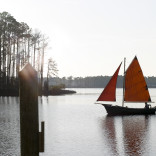

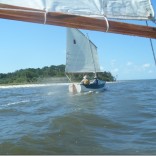
Fetch; Wind on Clear Lake.
May 21 – 22.
Monday morning I had my last breakfast with Dan and Mary. After getting out another blog entry, I thanked them for their company, hospitality and generosity and was on the road again. I was headed for Clear Lake, about 50 miles inland from the coast. Dan had told me one of their adventures on that lake being caught in a sudden freezing fierce wind and how they had tried to find an anchorage not getting much sleep that night. Dan had loaned me a storm jib and a drogue (underwater parachute to the boat slow down in high winds), not knowing that I would need that storm jib so soon! Thanks Dan! Driving inland I noticed the landscape change from coastal redwood forest to dryer grassy land with lots of oak trees.

Oak trees; a change in landscape

It definitely felt warmer getting out of the car at Clear Lake and the wind was blowing pretty good, kicking up whitecaps on the lake. The heating landmass inland sucks in the ocean air like a turbine. It starts early in the morning and just keeps going, as I were to find out. I first had to get an inspection sticker, stating that my boat was free from invasive plants. Dan had told me where to get one next to a launch ramp. After getting the sticker I didn’t feel good about launching right there, because being at the west corner of the lake there wouldn’t be much protection from the wind. After studying a map I noticed a small peninsula sticking out into the lake at Buckingham Point, with a marina and ramp. I looked like there would be some protection from that point east. There wouldn’t be as much fetch and more coves to hide in. Getting access to chart is a bit of a challenge when criss-crossing the country side. GPS doesn’t bother with lakes like this (at least not my chip) and buying charts for wherever you possibly may end up is too expensive. The woman at the front desk handed me a simple little map showing casino’s, campsites and restaurants, but it showed just enough to initially find my way around. Later I ended up with a map showing little more detail, but by no means a nautical chart.

Overall map of Clear Lake, with Buckingham Point in the middle

Map detail with the Buckingham Point on left
I made my way over there and talked to the marina manager. He in return asked the sheriff, who happened to sit right there, where I could find a sheltered anchorage for the night. The sheriff asked me if I was a good sailor because he didn’t want to ‘fetch’ me in the night (pun intended). Konocti Bay was what he recommended, with good protection from the wind, coming from the Northwest. It was about 6 PM when I motored out the protected marina and once outside noticed two foot breaking waves in The Narrows, rolling by the breakwater. I wasn’t going there, instead I was going to stay in the more sheltered area to the East, so put in two reefs and raised Dan’s storm jib. Now being in sheltered water means the waves are small, but the wind provides plenty challenges. It comes screaming over that hill in a rather unpredictable way. Moments of very little wind suddenly get followed up with abrupt gusts from various angels. It can slam into your sail and lean you way over, because the boat doesn’t have speed yet, accelerating the boat to over 5 knots quickly.

yellow storm jib


Once away from the so-called shelter, I got in a steadier breeze and reached downwind at a formidable speed of 6 to 6.5 knots. Landlubbers may not think much of this, but for a small boat sailor that’s pretty exciting! Fetch was starting to get on a plane in the gusts. I had my GPS out and once in a while it would read over 7 knots with one strong gust pushing us to 7.9 knots! Planing is pretty exciting, water shoots out both sides and the boat steadies as it gets on top of the water, rather than dragging through it. I hope you will excuse me from not having any photographs of Fetch planing!
The original boat as I bought it, called a Fulmar was designed by Iain Oughtred and was a sporty daysailer, light enough and with generous sail area (165 sf) to make her plane easily. As I converted her to a cruiser, I didn’t have planing in mind, but steady cruising. As I added structural weight in decks and cabin I also added 200 lbs of lead ballast to keep her upright. Instead of the original 400 lbs Fetch now weighs 1200 lbs. All in all, with the added weight and the double-reefed main with storm jib, she behaved splendidly. Never made me nervous, just enough adrenaline to provide an excellent exciting ride. Not that I wasn’t nervous, but that was residual nervousness from sailing her with her original working jib, which is twice the area (40 sf instead of 23 sf). The original jib hooks a little at the leech and is cut fuller, so it overpowers the boat in a stiff breeze. It takes a bit of time to gain trust in a boat in those circumstances under a new sail configuration. Even heading into the wind, she puts the rail down and just stays there, gently putting up with gusts. Instead of easing the main, I let here head up a little and ease off after the gust. Some violent gusts, like the ones coming over the hills, require easing he main in a hurry. Mind you, I have my hand on the main sheet at all times in these conditions. I installed the mainsheet jam cleat in the middle of the cockpit at deck level, just inches away from my hand, so I can ease her out in an instant and very controllably. I’ve also led the jib sheet to a spot well within reach so I never have to duck down to get it.
I found an excellent spot in the lee to spend the night. Instead of anchoring I opted to tie up to a dock and had a very simple dinner.


dinner
Sitting in my comfy reclining chair I read a bit in ‘The unlikely voyage of Jack the Crow’ by A J Mackinnon, a marvelous book that I had just borrowed from Dan. I crawled in my sleeping bag at about 9:30 and was trying to get used to all the noises around me. The gurgling of wavelets lapping against the laps of the hull (some people like this), the occasional groan of the dock lines, the wind in the trees on shore. At about midnight I still hadn’t slept yet and noticed the boat hitting the dock at times. That’s odd I thought, all this time we were pushed away from the dock. After a bit the boat started to roll as well as hitting the dock, once in a while rather harshly. I slowly started to come to the conclusion that I may have to do something about this, which is harder than it sounds when half asleep. I put some clothes on and stuck my head out of the hatch. It abruptly dawned to me that the wind had turned 180 degrees and was hitting me square on, slamming me into the dock. I could only assume that it would get worse in short order. The aforementioned wind turbine suddenly was running in reverse! I put my foulies on, started the motor and began to untie the dock lines. By now I even had a hard time keeping my balance on the heaving dock, so I kneeled down. In short order I backed away from the dock and was heading for shelter. It was pitch black and I realized that after a sun eclipse, the day before, there was not likely going to be moonlight any time soon.

Hauling Fetch in the middle of the night.
I was heading toward the other side of the cove, about a mile and a half away. Getting there, there wasn’t much shelter as the wind was ripping down the hill from different directions, but there were no waves except for a nervous rippling. I picked a spot and dropped anchor. Back in my sleeping bag I mused the fact that I always enjoyed reading about this kind of thing in voyaging books. Now I was the object of the theme. I don’t think I slept at all when around three o’clock the boat started to roll more and more. I wedged myself against the hull and tried to put up with it. After a while I poked my head outside and realized that the rolling was ridiculous. I didn’t have the centerboard lowered, slowing the roll down, because it bangs too much in the trunk. The rudder blade was up as well, to prevent damage from grounding in case of dragging the anchor, so the boat was rolling without any resistance. This was unacceptable, even at this time a day. The wind had come around 180 degrees and now I was on a lee shore once again. Somehow the wind and the waves didn’t line up, so Fetch was kept square to the waves, rolling viciously. Oh well, anchor up and motor back to where I came from was going to be the remedy. I didn’t put up too much fuss and tried to enjoy the occasion. Once back, I didn’t tie to the dock, but anchored nearby. I finally slept and woke up at eight, with bright sun peeking through the portholes.
I made coffee and had something to eat and realized I had to use the bathroom. I figured people ashore wouldn’t appreciate seeing me emptying a bucket with suspicious matter overboard and I visualized the very sheriff I had met earlier, fining me for polluting CLEAR Lake. So far I had never used my porta-potty on Fetch and it was way back under the cockpit seat. It took a while to move stuff around and figure out the logistics, but finally I got the job done. I remembered that two years ago, when designing and constructing the cockpit seats, I had made sure the porta-potty would fit there and that there would be a way to actually use it if need be. It paid off, as did many other arrangements I had to figure out. Satisfying? Sure, but sometimes it seems that buying a production boat where everything is worked out for you and doesn’t take ages to build is tempting. I wonder for instance how it would be to own and use a Montgomery 15 or a 17. Relative to the effort to build a boat, a production boat is darn cheap.
All around me there were many Grebes doing their ‘thing’. In mating season they pair up and show off their courtship dance, which is pretty bizarre and graceful at the same time. They dive down to pick up a bunch of vegetation and try to impress each other. Successively they do a series of graceful bows, picking at their feathers on their backs and end up in an almost vertical position in the water. As if that isn’t enough, occasionally they suddenly both start running side by side across the water with their bodies clear above the water and their heads straight out in front, ending in a simultaneous dive under water. I’ve seen this in a nature movie once and was glad to witness it first hand. Their sounds reminded me of frogs, but with a higher pitch.

Grebe


I studied the chart and scoped out different places to explore. It was too early to just head back, the sun was out, the wind was blowing and it was warm! I had gained confidence in my reduced rig so I decided to go downwind first, find some lunch and just deal with heading back into it later. Again Fetch behaved beautifully going downwind at 5 to 6 knots. The wind wasn’t as strong as last night (yet). I went around Gooseneck Point and past Oak Cove I found a small marina to tie up in.


I found a nice restaurant and had another fabulous chicken salad. Wine and coffee made me feel on top of it all. After all, I had a long beat to weather ahead of me. I was watching the waves on the lake, with white caps all over and white streaks and felt a little intimidated. To delay my fate I spend some time in a park photographing a Green Heron (didn’t let me come close though) and some turtles.


Green Heron, didn't let me come close

Back at Fetch the wind seemed as strong as the night before, about 20 to 25 knots, I reckoned. There was absolutely nobody on the water and I was wondering why, assuming that everybody was at work, this being a weekday. I didn’t want to wait it out, because this could just go on as I had experienced the day before.I raised just the double reefed main first to see what would happen going upwind. Fetch tried, but only got to about 2.5 knots, which was not acceptable considering that my destination was about 7 miles upwind. Going 2.5 knots while tacking under main alone, would mean a beat of at least 5 to 6 hours and it was 2:30 already. I raised the storm jib and suddenly we were going a steady 4.5 knots and occasionally 5. That was more like it! Waves were once in a while crashing over the bow and giving me a good dunking. I hadn’t put on my foulies, because they make me feel constrained and sweaty. However it was warm enough to keep me from getting soaked as my pants had a chance to dry some before the next dunking. It took a while to realize that everything was actually OK, that I wasn’t irresponsible, I was just beating to weather in a good breeze with the boat trimmed just right. No weather helm, but nicely balanced, making good head way into the wind. I tacked in about 110 degrees. Sailing into these waves at 4.5 knots at about 55 degrees off the wind was just dandy for little Fetch, I thought.
I sailed big tacks across the lake, seeking for a bit of relieve at the other side. However I realized that while the waves are indeed lessened under the lee of a hill, the winds are instead harder to deal with. It comes twirling down those hills in an unpredictable manner and force that make you have to pay attention every moment. It was a toss up whether to prefer the more steady wind and higher waves in the middle of the lake. After about 3 hours of this I gladly slid into the marina entrance. I realized that out on the ocean one would be in this and much worse for days on end. Somehow that didn’t appeal to me at the moment, I was happy to be at the ramp. That night at the camp spot I was rewarded with a nice sunset.

reward


23 May
10 Comments