 Artwork from the logbook of the ship Iris while on its voyage from 1843-1847. The painting depicts a sperm whale upending one of the whaleboats chasing it.
Courtesy Girl on a Whaleship
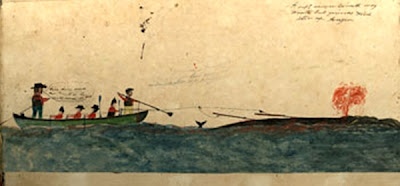 This detailed painting of the killing of a whale by a whaleboat crew was done on the inside cover of a logbook. The logbook covers two voyages; the ship Alexander Barclay, 1837-1840 and Charles W. Morgan, 1841-1842.
Courtesy Girl on a Whaleship
 Diagram ({{Information |Description={{en|1=Side and interior plan of whale-boat equipped with apparatus of capture, &c. Noted on the drawing as Plate 192. sec 5 v ii pp241, 252. not clear why the file name says fig 193.}} |Source=NOAA Photolibrary Image ID: figb01)
Courtesy NOAA

Azorean whaleboat racing
C0urtesy Azorean Whaleboats
 The past–a district Missionary’s whaleboat
In early days the work of the “Southern Cross” was supplemented by the district missionaries in their whaleboats, but in recent year these have been replaced by launches and schooners
Courtesy Anglican History Oceania 1849-1949
 from ‘Into the Deep’, a documentary by Ric BurnsThe history of the American whaling industry from its 17th-century origins in drift and shore whaling off the coast of New England and Cape Cod, through the golden age of deep ocean whaling, and on to its demise in the decades following the American Civil War.
Find here, and here.
I just happened to catch the airing of this documentary on PBS, I rarely watch TV so it was extremely fortuitous. I was deeply moved and impressed by this work.
Ric Burns is without doubt a most discerning and articulate documentry filmaker. I recommend this film highly. It focuses acutely on the wreck of the Essex, an American whaleship and more generally on American whaling. The wreck of the Essex is reputed to be one of the inspirations for Moby Dick, and the documentary focuses quite a bit on Melville’s celebrated work. Do not miss this!
Courtesy Ric Burns, PBS, and Mystic Seaport

Aquatic Mammals
Caption: Darting Harpoon into Sperm Whale
Image Date 1926
Subject Whaleboats
Whaling
Harpoons
Sperm whale
Image Source Author Cook, John A.
Image Source Title Pursuing the Whale : a Quarter-Century of Whaling in the Arctic
Pub. Info. Boston, MA : Houghton Mifflin Company, 1926
Page No./Plate No. Facing page 8
Digital collection Freshwater and Marine Image Bank
Repository Most materials are located in the University of Washington Libraries. Images were scanned by staff of the UW Fisheries-Oceanography Library
Copyright Materials in the Freshwater and Marine Image Bank are in the public domain. No copyright permissions are needed. Acknowledgement of the Freshwater and Marine Image Bank as a source for borrowed images is requested.
Ordering Information The University of Washington Libraries does not provide reproductions of this image. This record contains a citation for this image. If you want to use the scanned image, acknowledgement of the Freshwater and Marine Image Bank as a source for borrowed images is requested.
Type Image
Courtesy University of Washington Libraries

Courtesy Girl on a Whaleship
From the introduction to ‘ The Whaleboat A study of Design, Construction and Use from 1850 to 1970 by Willits D. Ansel, published by the Mystic Seaport Museum:
The term “whaleboat” properly describes boats used for hunting whales, lthough it has also been applied to other boats having similar features, generally sharp ends. Whaleboats ere used by the thousands aboard American whaleships in the middle of the nineteenth century and, in lesser numbers, aboard the vessels of toher nations and at shore stations around the world. The whaleboat was a double ended, light, open boat with a length at that time of between twenty-seven and thirty-one feet and a beam of slightly more than one-fifth the length. It was pulled by oars and sailed. It was a fine sea boat, not only adapted to its function but also handsome. Though there were variations in size, lines, and construction, the general characteristics were well defined.
The whaleboat was once the most widespread of all small craft. In the late 1800s it was known in the Pacific in such widely separated places as Easter Island, Tasmania, the Bonin Islands and the Aleutians. In the Atlantic, it appeared in the north off Greenland, in the Azores, the Grenadines, and south to Tristan da Cunha and still farther south to Antarctica. In the Indian Ocean it was seen in the Mozambique Channel, Kerguelen Island and Cocos. It was used in the Arctic Ocean at Herschel Island on one side and Spitsbergen on the other. Whaleboats were seen in the most remote places in the sea.
The last voyage of a whaleship that carried whaleboats was in the 1920s. At a few far scattered places the boats continued to be used for shore whaling, as at Tong and Norfolk Island in the Pacific and at Bequia and the Portuguese Islands in the Atlantic. Two whaleboats are still maintained at Bequia and whaling on Pico and Madeira.* In 1969 there was whaling at Fiji. Elsewhere on remote islands the type survived for carrying cargo and passengers.
In the United States, where the whaleboat was carried to its final stage of development and where the boats were build by the thousands, very few remain outside of museums, although an undermined number survive in Alaska.
Much has been written in praise of whaleboats:
Their shape “ensures great swiftness as well as qualities of an excellent seaboat.” 1
The boats were dry and rode “as gracefully as an albatross…for lightness and form, for carrying capacity compared with its weight and sea-going qualities, for speed andfacility of movement at the word of command, for theplacing of menat the best advantage in the exercise of their power, by the nicest adaptation of the varying length of the oar to its position in the boat, and lastly, for a simpicity of construction which renders repairs practicable on ships, the whaleboat is simply as perfect as the combined skill” of generations of boatbuilders could make it. 2
As surf boats the whaleboats were “without rival, better than a lifeboat which is a compromise because it has to carry a larger number of people…The whaleboat was the best seaboat that man could devise with no limits to size, weight, or model. “3 A whaleboat type, locally called a longboat, was adapted on Tristan da Cunha around 1886, after fifteen men were lost in a lifeboat. The longboat coxswains conider their light, canvas covered boats fine surf boats. 4
Howard Chapelle cites the whaleboat’s reputation for good performance under oars and sail under all conditions.5 Others noted their maneuverability and speed and, last but not least, the cheapness of their construction.
Such praise was deserved. However, the whaleboat was the product of compromises, and was excelled in some functions by specialized boats. There were faster pulling boats, such a certain ones used in nineteenth-century smuggling in southern England, and certainly some lifesaving boats were safer in surf or a breaking sea. In terms of all-around performance, however, the whaleboat rated very high.
1. Charles M. Scammon, The Maritime Mammels of the Northewest coast of North America and the Whale Fishery, rev. ed. (Riverside: Manessier Publishing Co., 1969), p.224.
2. William Davis, Nimrods of the Sea, rev. ed. (North Quincy: The Christopher Publishing House, 1972), pp157-58.
3. Clifford W. Ashley, The Yankee Whaler, (Garden City: Halcyon House, 1942), p.59.
4. Notes on the Tristan da Cunha boats were provided by the island’s administrator, J. I. H. Fleming, in 1973.
5. Howard I. Chapelle, The National Watercraft Collection, (Washington, D.C., Goverment Printing Office. 1960), p. 262
* Whaling was banned in the Azores in either 1986 or 1987, even though other small groups of shore based whaling, such as the Inuit and the Bequian whalers were allowed to continue as their whaling is considered ‘indigenous’. It’s my belief that the Azoreans should also be allowed to take whales based on their long standing practice. (ed.)
While not meant to condone the wholesale industrial slaughter of whales by, in particular, Japan and Norway, I do feel the history and development of the whaleboat a legitimate area of inquiry.
Currently I am writing a weblog about the construction of two whaleboats being built to fit out the restoration of the Charles W Morgan underway at Mystic Seaport. The boats are being built to historic standards at both the Indepen





 It took 4 tries to get it right, but we got it.


13 Aug
0 Comments