13 Mar

0 Comments

Lofting 1.0, preliminaries

by


Imprimature

photo Thomas Armstrong


Sorry about the quality here, but a more defined photo might infringe on Mystic copyright.
Drawn by RC Allyn in 1974, lines taken off a Beetle Mfg. Co. boat that arrived with the CW Morgan.

photo Thomas Armstrong


Batten pinned

photo courtesy Wendy Byar


Lofting floor

photo courtesy Wendy Byar


photo courtesy Wendy Byar

from Wikipedia:

Lofting is a Drafting technique (sometimes using mathematical tables) whereby curved lines are drawn on wood and the wood then cut for advanced woodworking. The technique can be as simple as bending a flexible object (such as a long cane) so that it passes over three non-linear points and scribing the resultant curved line, or plotting the line using computers or mathematical tables.
Lofting is particularly useful in boat building, when it is used to draw and cut pieces for hulls and keels, which are usually curved, often in three dimensions.
Lofting is the transfer of a Lines Plan to a Full Sized Plan. This helps to assure that the boat will be accurate in its layout and pleasing in appearance. There are many methods to loft a set of plans.
Generally, boat building books have a detailed description of the lofting process, beyond the scope of this article. Plans can be lofted on a level wooden floor, marking heavy paper such as Red Rosin for the full sized plans or directly on plywood sheets.
The first step is to lay out the grid, mark the Base Line along the length of the paper or plywood sheet. Then nail Battens every 12 inches (or more in some cases) where the station lines are to be set as a mark for the perpendicular line, which is marked with a T-square. The previous steps are followed in turn by marking the Top Line and the Water Line. Before continuing make sure to check the lines by using the Pythagorean theorem and make sure the grid is square.
The second step is to mark the points from the table of offsets. All measurements off the table of offsets are listed in Millimeters or the Feet, Inches and Eighths. The points are plotted at each station then use a small nail and a batten to Fair (draw with a fair curve) the boat’s lines.

from Wendy Byar:

“The beginning of a new boat means drawing the shapes full size from a set of offsets (feet-inches-eighths) that determine points. Battens bent to meet these points are adjusted for fair curves.

The plans for the whaleboats being built at Workshop on the Water and Rocking the Boat are available from Mystic Seaport. These drawings were done by R.C Allyn in 1973. They are the lines from a Beetle Whaleboat. Beetle built about 50 boats a year between 1834 and 1854. A set of lines like this gives all the information a builder needs to produce a boat with the given shape.
The plans for the Whaleboat have a table of offsets in the corner. The offsets are read in feet-inches- and eighths of inches. These coordinates specify points on given lines. They are the given locations where a long flexible batten may be bent along to make a fair line.
The lines on the plans are drawn in three axes, or planes intersecting each other at right angles for the most part. (the diagonals make a fourth set of planes, not at right angles.)

The whaleboat we are building at the Workshop on the Water is about 28 feet long, so we need a drawing surface at least that long.
Four sheets of luan were screwed to the wooden floor and painted white for good contrast with the pencil lines. The paint makes it easier to erase, too.
A baseline was laid down using a very tightly stretched string. Marks were made along one side of the string and a 30′ straight line was drawn using a straight edge to connect the marks. This line needed to be true since the rest of the boats geometry is drawn in relation to it.
Station lines were set up every three feet along the base line as indicated on the plans. These lines are 90º to the baseline. They were drawn using the 3, 4, 5 triangle method to assure right angles. Each station line was labeled with its number.”

There’s more to come on the lofting soon, The photos above are from a trial lofting for educational purposes, the boat will be re-lofted soon, and we plan to follow that. (ed.)
Filed Under: Uncategorized

12 Mar

0 Comments

Whaleboats 101

by

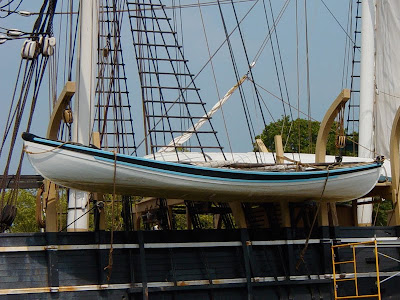
Whaleboat in davits on the CW Morgan, Mystic Seaport

photo courtesy Mystic Seaport


Whaleboat exhibit at Chubb’s Wharf at Mystic. This boat came to Mystic in 1941 aboard the CW Morgan but is believed to have been built before 1920. It is fully kitted out with whaling gear representative of the 1880’s.

photo courtesy Mystic Seaport

Newly minted (2003) whaleboat built at Mystic by a team headed by Walter and Willits Ansel.
Willits came out of retirement for this boat, to build ‘one more’, the project manager being his son Walter. Tom Jackson was a member of the team and wrote an article for WoodenBoat which is must read.

Photo courtesy Michael Eudenbach

Long and lean, fast and graceful, the brutality of the whaleboat as an eloquently evolved weapon is belied by the elegance of their lines. Light, efficient and lethal. These are the boats that were employed by whaling ships to close the end game. They are an example of the evolution of form in service to function that has resulted in sheer artistry born of utility.
The last traditional whaleboat built in this country was built in 1933 by the beetle Mfg. Co. of New Bedford MA. for the Maritime Museum in Newport News. The boats had long been built by Beetle and they supplied much of the American whaling industry. The legacy of American whaleboats has been kept alive by Mystic Seaport and in particular Willits Ansel who, while serving as a shipwright at Mystic initiated the the building of whaleboats there. He also ‘wrote the book’ on whaleboats. I cannot explain the crazy price for the book at Amazon right now, I recently ordered the book for around $35. Take a look also at Tom Jackson’s article on Willits and his son Walter building a whaleboat at Mystic featured in WoodenBoat #171. The boats we will be following here are being built to plans from Mystic, I believe Beetle plans. The work should commence at the ISM’s WoW in a couple of weeks, lofting has already taken place and we should have an article on that in a day or so from one of my companions or guest editors in this endeavor, Wen Byar. Hope you enjoy this!

Filed Under: Uncategorized

12 Mar

0 Comments

Whaleboats for the CW Morgan

by

A quick post to announce a new weblog I am hosting at the behest of John Brady, lead boatbuilder at the Workshop on the Water, the very active boatshop at the Independence Seaport Museum. Wow and Rocking the Boat in NYC have been commissioned to build a whaleboat each, with the goal of fitting out the restoration of the CW Morgan at Mystic Seaport in grand style. These boats will be built in a traditional manner, a combination of lapstrake and carvel planking, lap for the top few strakes and carvel lower down. Originally built all lapstrake, traditional builders and the whalermen themselves came to prefer the quieter carvel planked construction because it was less likely to alert a whale to it’s impending demise. The boats will allow for 5 or 6 crew with rowing stations and gunter rigged sailplans. After their completion, they may be allowed to play a bit before joining the Morgan for her first voyage, to New Bedford, MA.
John will be leading the team in Philadelphia. The lofting is complete and we should have a post by Wendy Byar soon on that. The plan is next to build two sets of molds for the boat in Philadelphia with one set being sent to NY. That work is expected to commence in a week or two.
The build in NY will be led by Geoff McKonly, late of Philadelphia where he was the head of the Philadelphia Wooden Boat Factory for many years. Other institutions may also get involved with builds of their own.
This should be a rewarding couple of builds to follow, and I hope to keep it up at least to the first voyage of the Morgan to New Bedford, we will see what happens after that. I hope you’ll stay with us.

And please will some one of my loyal readers have the grace to christen the new weblog, not with champagne but a comment?

Here’s the link, Whaleboats for the CW Morgan

Filed Under: Uncategorized

07 Mar

0 Comments

Largesse at Mystic Seaport

by

Rigging


Blocks


Boats


Figureheads


Motors

While working through Carl Swebilus’ massive thread on the WoodenBoat Forum, there was a lot of compelling material I had to pass by in order to stay focused on the story of the ongoing work of restoring the CW Morgan (see my previous posts). Carl’s material is very rich, and lifts the veil for those of us not privy to ‘behind the scenes’ at this great resource. One of the most striking glimpses was a view into the sheer immensity of the collection and stores at Mystic Seaport. I felt compelled to share a bit of that here. As the work on the Morgan continues towards a 2012 splash, I will likely update the progress. And I will soon have a first post for the weblog on the building of the whaleboats for the Morgan. Let ya know.

Thomas Armstrong @ 70.8%

Filed Under: Uncategorized