13 Dec

0 Comments

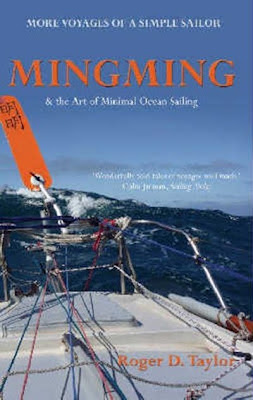
MINGMING & the Art of Minimal Ocean Sailing
by

the cover of Roger’s latest offering


Mingming‘s voyages

2007

2000 miles under patched up battens, 2007


Whales through the Porthole


Piloting Pilot Whales west of Ireland 2007


Pilot Whales West of Ireland 2007

2008


Jester Azores Fleet, Plymouth 2008


Leaving Plymouth for the Azores, Jester astern


Azores Arrival (Photo Tony Head)


Leaving the Azores for Plymouth, 2008

2009

Sailing North to the sun, 2009

Inside Mingming

Approaching southern Jan Mayen

Arctic ice

and again,ice

Yet more…ice

Coast of Jan Mayen 2009

Snaefell Glacier, West Iceland

Off north-west Iceland


Leaving Adalvik, NW Iceland

all photos and captions Roger Taylor

“There are, according to the tetrahedral view of the earth, four oceans; but of these three only are generally necessary to navigation, for the Arctic Ocean is only used by Polar bears and Polar explorers, and in any case not navigable.”

So mused the intrepid Irish circumnavigator Conor O’Brien in the opening sentence of his account of his sail around the globe ‘Three Oceans’, published in 1928. 82 years on, I think Roger Taylor would take exception to that, though certainly not to it’s author, whose adventurous spirit mirrors his own.

MINGMING & the Art of Minimal Ocean Sailing‘ is Roger’s second book. His first, ‘Voyages of a Simple Sailor‘, tells of the events which have led him to his current philosophy and practice of ocean cruising. This new book deals with the implementation and execution of his ideas, and the results of his experiments in real tests, his cruises. He is building on the innovations and experience of his mentors, Blondie Hasler and Mike Ritchie, pioneers of small boat singlehanded ocean cruising. He also brings to his projects a wealth of hard won personal experience gained through a lifetime of sailing. But I don’t want to give a false impression. These are not clinical trials. Roger’s cruises are his passion. Though he only goes to sea once a year for six to eight weeks, leaving behind his duties as head of an investment management company, his entire year revolves around the planning and preparation for this escape to the solitude and grandeur of oceanic wilderness. It’s remarkable that Roger conducts his forays into the Atlantic, the North Sea and the Arctic Ocean in a little 20’7″ Corribee MkII, Mingming. Not only is she small, she’s also junk rigged and has twin bilge keels, which according to some sailing pundits should make her next to unsailable. Roger’s adventures prove otherwise, and I’d hazard a guess that at times he regards her as a living being. She’s been heavily modified to allow singlehanded sailing from the warmth and safety of her cabin. Here’s Roger on first the planning for his 2007 cruise, then his preparations and modifications to Mingming:

The winter evenings gripped tighter, darker, colder, but I cared little. I had work to do. I may well have been intending to simply set off and see what happened, but this did not in any way presuppose some sort of lax approach to the problem. True freedom of the seas, especially for the sailor of a tiny, engineless yacht, can only be derived from the most rigorous preparation. More than fifty years of sailing had honed my wariness to razor sharpness. Having concieved the general shape of my intended journy, I now had to drill down into the smallest navigational details. Every aspect of the potential routes had to be explored. I had to think through every possible adverse situation to insure that, in the worst case, I would not be putting myself and Mingming at risk.”

And later on, three major modifications to Mingming: Tuning his self steering to allow for infinitely fine adjustments…without having to go on deck, adding protection from spray and weather around the main hatch, and giving her a proper bowsprit.

My winter preparations for the voyage north were therefore of a dual nature. Contemplation was supported by carpentry. The kitchen worktops, ideal for heavy duty clamping requirements, particularly when it was too cold to work in my garage workshop, were littered with weird works in progress and their constituent parts, along with the saws, files, chisels, glues, screws and so on used to construct them. In the lounge and by the bedside the piles of charts and pilot books and almanacs grew steadily higher. To sail properly, and by that I mean to go to sea unequivocally and without compromise for a month or two each year is a year round business. The preparatory ten months are as integral to the project as the weeks afloat. They are almost as satisfying, too. The more time and effort that go into creating a successful modification, and indeed a successful cruise, the greater the pleasure of experiencing that success during the weeks at sea.”

One has to wonder where the time was found to write this book.

Roger goes on to recount three voyages taking place in ’07, ’08 and ’09, two tales of northing and one southern cruise to the Azores. His straightforward accounts of sailing are interspersed with musings on the nature of his projects, and they pull you along with him and Mingming quite skilfully. This is not, in my estimation, your run of the mill cruising yarn ( and I’ve read lots ). In the interest of brevity here, and so as not to spoil any surprises, I’ll leave the rest for you to discover.
The scale of what Roger Taylor is achieving with these cruises brings to mind Joshua Slocum and Webb Chiles, to name a couple. Like those intrepid sailors, he is pushing at the edge of the possible.
Inevitably, I questioned Roger on his influences. Here’s his reply:

“Hasler

Richey

Slocum

Guzzwell

My real guiding light, for all his faults (see the article on my website for that) is Bill Tilman. He was of course sailing big fully crewed craft, so with him it’s not about technique but attitude.

And of course Moitessier, whom I met in NZ in the 70s.”

I asked Roger to expand on his meeting with Moitessier. His response :

“Nothing to tell, really. He had Joshua on the hard for a while at Opua in the Bay of Islands, where I kept Roc after her Tasman crossings. This was mid-70s, so he hadn’t quite established his legendary status. He was just a fairly well known French sailor. We just had a nodding acquaintance. Can’t even remember exactly what he looked like, apart from a shock of hair. I look back now and think what a missed opportunity it was. If I knew then what I know now I’d have made a much greater effort to get to know him – and I’d have been down there with a camera looking for photo opportunities!

Too late now…”

I hope you’ll enjoy Roger and Mingming‘s adventures as much as I do, and please visit his website.

You can order the book directly from Roger here, or from my Amazon bookstore, too the right.

A great last minute gift idea.

I’ve never met Roger Taylor in person, but we have had many exchanges (see my earlier posts) and some dealings over the years, and I count him a friend. I’m sure that he’s a quiet, retiring type in a crowd, but he opens up deeply when writing. And, I recently persuaded him to join facebook, look for him there.

Filed Under: Uncategorized

03 Dec

0 Comments

Antonio Dias Boat Design

by


Harry


Early days

Harrier

Ran Tan

“If I had to chose, Harrier is my favorite boat. Small enough and still feels capable in fairly big water. The fastest I’ve ever been on a monohull, hydroplaning on her bottom plank like a ski at well over ten knots in a cold hard Northwester in Saint Michael’s.”


Ben Fuller sculling


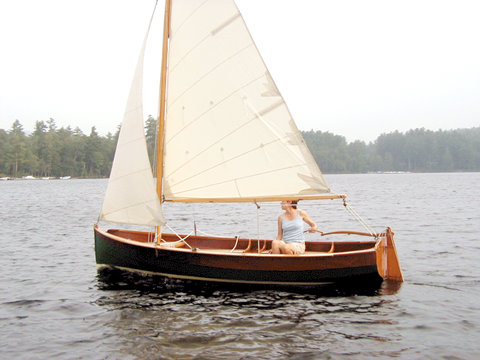
Sailing trials were conducted by Jenny Bennett and Antonio for her article on Ran Tan which appeared in WoodenBoat’s 2009 Small Boats


Trials with Jenny at the tiller


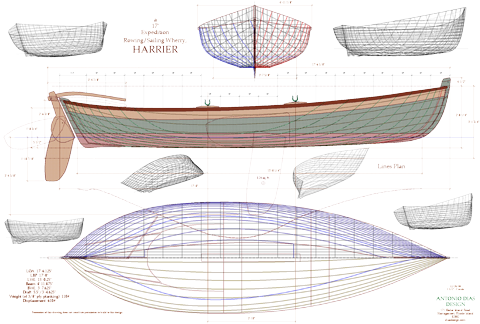
Harrier is a modified wherry hull form and sports carbon spars for it’s lovely lug yawl rig


Owner and imaginer of Harrier, Ben Fuller on a reach.Ben is a small boat historian, former curator at Mystic and currently curator at the Penobscot Marine Museum. Ben authored a book on small boat plans available at Mystic Seaport Museum, it’s on my wish list

Ran Tan photos courtesy Katherine Mehls

Antonio Dias’ CAD drawings for Harrier

Small


Jenny Bennett, a respected small boat journalist, worked with Antonio and builder Will Clements to produce her(modified for reality) dream boat, Small. Here she’s getting ready for a sail, I believe her first in the boat.
Later in the day she was joined by designer and builder for the sea trials.


There’s an article about Small, written by Jenny and featuring the clean, sharp photos of Benjamin Mendlowitz, in WoodenBoat number 181. Recommended

From Tony
“Small: Fast Harry calmed down and made civilized. Jenny really helped shape this design. I particularly like the low foredeck she specified.

The workboat heritage of Small, an expression by Jenny’s desire for a design reminiscent of her English upbringing, is evident here, especially in the plumb bow. Notice also the unvarnished teak deck and benches.


Reaching off

Arey’s Pond Daysailer


“Arey’s Pond Daysailer:
The challenge for a fast boat that could be skippered by a couple in their eighties and float in 13″ of water. The virtuous cycles that built up between the hull, skeg and winged rudder, combined with the carbon fiber rig surpassed my wildest hopes. Fast, easy, no pressure on the helm even at 7+ knots on a broad reach. I’ve been told her helm feels like the new America’s Cup boats that way”. Read Tony’s design brief here.

The starting point for this design was Chapelle’s collected Kingston Lobster Boat by Ed Ransom, page 161, American Small Sailing Craft)

There’s an excellent article on this boat in WB #186 written by Mr. Dias’ long time friend and associate
Rueben Smith

Arey’s Pond photos courtesy Katherine Mehls

Beach Point 18


Beach Point18, docked at Arey’s Pond


“A lot of cabin for the size, but a snug sailer, fast and with the yawl rig she maintains steerage even at a snails pace, so ghosting in close quarters is precise. A stretched out 20′ or 22′ would really be something.”


Cabin


Cockpit


Mizzen

Spar Hawk


Spar Hawks copious lug yawl sail plan

Katrina (a Harry type) , SparHawk, Harry,
and their owners; Antonio, Tom Haines, and Jim Carr.

“My Sailing Canoe design. A bit over-canvased for modern taste. A good hull form. Low wave making. Good though heavy paddling boat.”


S & S Hammond


S & S Hammond:
Steve is a clammer and fisherman in Chatham, and old Yankee family, he’s building the boat slowly, carefully. His ambition, and I hope to join him, is to sail out of Chatham harbor and go east, about a hundred miles. We’ll drop some handlines over the side and see if there’s a codfish willing to join us on her decks.
More and updates here.

Truth


Truth:
“Crossed the Gulf of Maine to Provincetown from Brooklin in a Southeast blow. Never took a drop on deck. Rode across genuine 8′ to 10′ graybeards off the quarter as if on rails with two fingers on the tiller and over six knots under stays’l alone. Composting toilet, good cabin, standing headroom. At hull speed the wake is inches high.


Truth Sail Plan

current project:
Martha’s Vineyard Catboat


“Marty Harris is building this new 12’9″ Cape Cod Catboat design on Martha’s Vineyard. She’s going to sail in the Lagoon in Vineyard Haven next summer. Until we get shots of her underway, I’ll be adding construction photos as they come to me. You can also follow her construction on Marty’s site.”
Some comments on this design from Jeff Halpern, a friend of
Tony and a racing companion
:

As I see the design, its is a creative blending of some of elements of the early planning dinghy hull-forms (such as Uffa Fox‘s late 1930′s designs or Harry*) with the classic catboat typology. It is fun to read your drawings and see those places where the lines subtly stray form the mundane; to see the slight hollow in the waterlines at the bow and gentle flam of the topsides forward, and think of this passing through a wave, neither so fine that she porpoises, not so blunt that the bow collides forcefully with each wave, and with just enough flare to keep her dry. Similarly, I look at the stern and see the beauty of the tumble-home and raked transom, and your cleanly drawn run, so hard to achieve with this much beam, which should produce enough lift to surf and perhaps even plane in the right conditions. What a blast on a quiet Sunday afternoon, or a with a bone in her teeth, blasting back home with the wind from her quarter!…

All photos and other material courtesy Antonio Dias unless otherwise noted


Antonio Dias is if anything a thoughtful designer. Very thoughtful. This manifests in several ways, his attention to tradition, his attention to adapting tradition to serve his clients needs, and his attention to detail, expressed both in his boats and his finely crafted drawings. That said, he’s also a designer who does not shy from using modern technology when it is appropriate. Witness Ran Tan‘s carbon fiber spars and the delta wing stabilizer (Tony says this is an aviation term, He thinks of it as more of a resolved endplate) on the Arey’s Pond rudder, for instance. Tony is also interested in flight and worked for a time in the aviation design world.

In working on this article, I’ve had a deeper exchange with Tony than is usual with the people I write about, again, a testament to his attention to detail. This exchange of ideas and opinions has led to insights for both of us. Apparently a comment I made was a tipping point which led to Tony’s understanding of boats not only as tangible objects but also as vessels of inner transformation, great archetypes of the human psyche. The exchange has benefited my perception of boat as well, deepened it and enlightened it. This has resulted in Antonio initiating a conversation about boats and their relevance to our lives in the form of a blog intended to be a sort of open forum about the meaning of boats called Boats for Difficult Times. I have posted some comments there and intend to write some more lengthy pieces for the blog, it is an interesting line of investigation.

Tony is a sort of renaissance man, a poet, painter and writer with talents, accomplishments and aspirations ranging beyond boat design. One can ferret these out by reading his other blogs, Fine Lines and Horizons of Significance and through other links found at Antonio Dias Design.

Antonio Dias is also the author of Designer and Client, a book about the design process and the interaction between the two parties. It’s a candid look into what is usually an undisclosed process (often for good reason). I’ve only read bits of the book, but what I have read is compelling enough to suggest a more thorough read. I was particularly struck by one paragraph in the introduction which is relevant to Tony’s current thoughts being aired on Boats for Difficult Times and which has bearing on our recent exchanges:

It May seem ludicrous to expect boats-and pleasure boats at that-to be vehicles for a search for truth. Aren’t they toys, conspicuous consumption,status symbols? How could they be anything else? Twenty -odd years down this path, I must say that I still have reason to doubt this conventional wisdom. I continue to see glimmers of the transformative power inherent in boats and refuse to abandon my expectations.

Antonio Dias is that rare individual who truly examines life and the issues surrounding him, and who uses the lens of one discipline to examine another, and then turns it around. This, to my mind is a philosopher. Not to be to heavy handed, let’s call him a ‘philosopher of boat’.

In writing about Tony Dias, I have perhaps focused more on the man than the boats, but there is ample information on his highly regarded boat design work. You can access his website to review a portfolio of his boats, dig into ‘Designer and Client’ for eight of his projects, and find great articles on three of his brainchildren in WoodenBoat publications,
Small is featured in WB # 181
the Arey’s Pond Daysailer in WB # 186
and Harrier in the 2009 edition of Small Boats.
All of these can be requisitioned from WoodenBoat in their original form or downloaded in a digital format.

Filed Under: Uncategorized

03 Dec

0 Comments

Old Weather: Swords into Plowshares

by


Rosario
submarine depot ship, ex-sloop, Condor-class, was 980t, 1898(l), 6-4in, 13kts, 130 crew. Sold 1921
Nov 1913-Sep 1918, China, Hong Kong


Similar but unidentified depot ship, with old submarines alongside (Maritime Quest)


Log of Rosario


Torch
old sloop, Alert-class, 960t, 1895(c), 6-4in, 13kts, 106 crew. Sold 1920
Mar 1914-Nov 1914, May 1918-Aug 1922, Pacific


Log of Torch


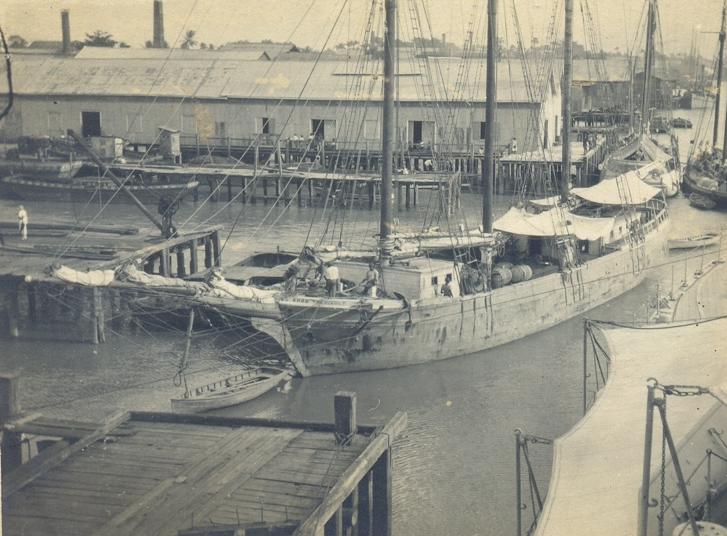
rum-running schooner waiting to load up at Demerara, British Guiana during US prohibition 1924
(Yeoman of Signals George Smith)

Logs courtesy Old Weather

Images courtesy NAVAL-HISTORY.NET 1998-2010
working with National Maritime Museum & Citizen Science Alliance/University of Oxford

Here is a very engaging project which is truly interactive internet at it’s best. A project which will appeal to all generations, from the youngest, greenest (climate change) activist to the older veterans of the wars and all in between, a unifying force for collaboration. And a chance to easily make a contribution to and participate in scientific research which can help us understand where we stand in terms of climate change and inform our future. And it’s fun. Here’s what you can do, anyone can do. Go to the Old Weather website, read the intro, review a couple of the tutorials and get to work. You’ll pick a vessel of your choice and join a crew of other folks working on the same boat. Your task will be to log some entries into the database by viewing the actual log entry of your chosen ship. The entries will pertain to the location of the vessel, the weather entries of the day, and the log of events aboard ship for any given day, which can range from tedious to exhilarating. Tis a cool magnifying glass thingie which will help you read the entries. And it all goes to helping science understand where we are in terms of the geologically recent past, in order to grasp weather changes over the last century. to wit:

Introduction:
Help scientists recover worldwide weather observations made by Royal Navy ships around the time of World War I. These transcriptions will contribute to climate model projections and improve a database of weather extremes. Historians will use your work to track past ship movements and the stories of the people on board.

There are links to photos and a synopsis of each vessel’s history. This is a well conceived and executed project, a joint effort of several UK institutions. An example of interdisciplinary sharing, and an engaging of the public to share in the grunt work of scientific research that should and hopefully will be taken note of. This works, and in my opinion, it rocks.

Take the data from these ships and the history from these ships, engaged in warfare, and, turning swords into plowshares, help the understanding of climate change and help tell their stories. This is redemption in action. Turning weapons into data into understanding into prediction ( I guess) and into action (I hope).

Filed Under: Uncategorized