22 Aug

5 Comments

Fetch: First week in Maine

by

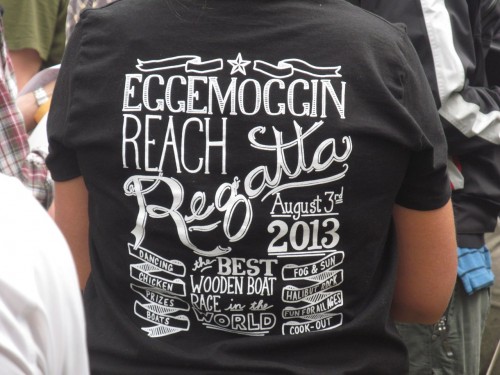
After I arrived at the WoodenBoat School I learned that I was just in time for two great events. One was the Eggemoggin Reach Regatta and the other was the Small Reach Regatta.  I’ll show you the second in the next post.


I finally made it to Maine


arriving at night


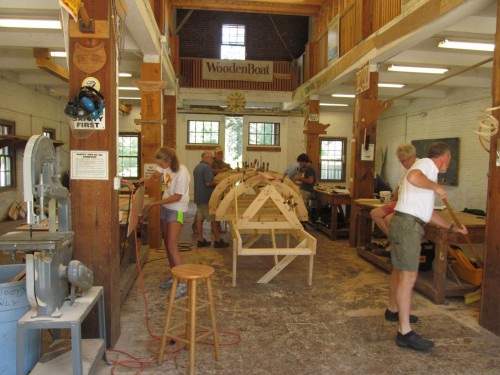
The WoodenBoat School is located on a beautiful 60 acre waterfront site, that also houses the WoodenBoat Store and the publication building of WoodenBoat Magazine and Professional BoatBuilder. Everything appears in great shape and well organized. Every week there are many different classes, most of which are fully booked. Some students camp on site and some stay in student housing just up the road in Brooklin. Breakfast, lunch and dinner are served for whoever signs up. Staff is very friendly and professional. Quite a place indeed.


publication building


one of the school buildings


start of an Arctic Tern


steam boat restoration


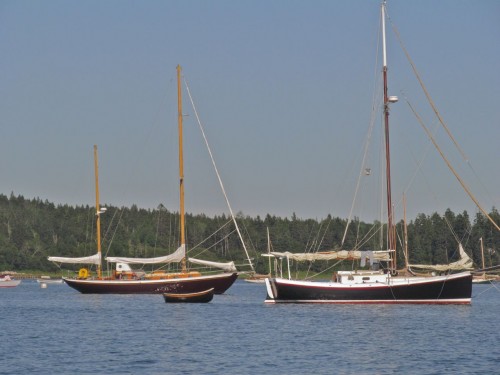
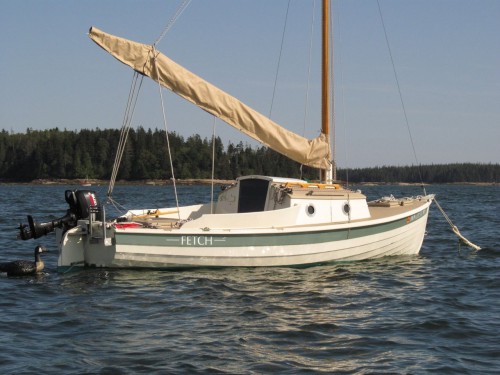
Down at the water there is a beautiful boathouse where the on-the-water classes are based. Out in front is a whole assortment of wooden row and sail boats tied to there moorings, that are used for classes during the day and are available for students after 5 PM. Launches zoom back and forth bringing students to there boats and back. Fetch gets launched and I get the use of one of the guest moorings, so I don’t have to worry about my anchor holding.  Schooners (windjammers) from Rockland come in in the afternoon to have a sunset lobster dinner on the beach across the bay.


boat house


launches at the float


fleet moored ready for classes


Beetle Cat in the fog


a Gartside design


guest boats


visit of a windjammer


push boat along side (the schooner doesn’t have an engine)


Fetch at a guest mooring

Caledonia Yawl of instructor Geoff Kerr


this Mackinaw Boat is part of the fleet


the Mackinaw Boat slips along easily


visiting norwegian Faering built in Rockland and a dory


I went by the Brooklin Boatyard on a foggy day and enjoyed the waterfront of Center Harbor. I visited Eric Dow’s shop just up the road. Eric was my instructor in Seattle Center for Wooden Boats years ago. For a long time he specialized in building Havens, but now he focuses on winter storage and maintenance. I stopped briefly by Brion Rieff’s shop where several new builds were underway.


Center Harbor in a fog


lots of beauty floating about


Eric Dow


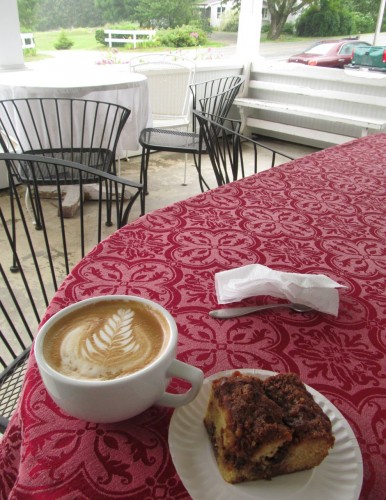
Latte at the ‘Cave’


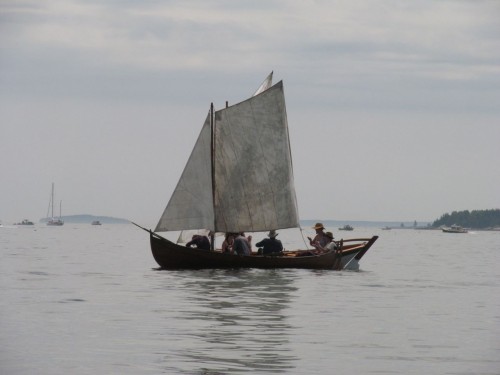
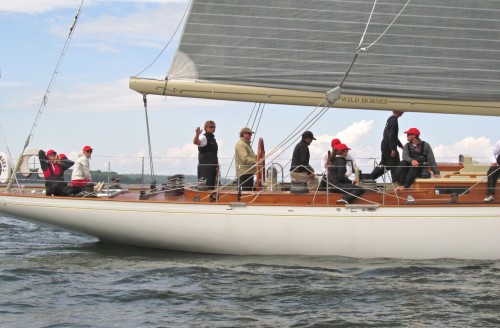
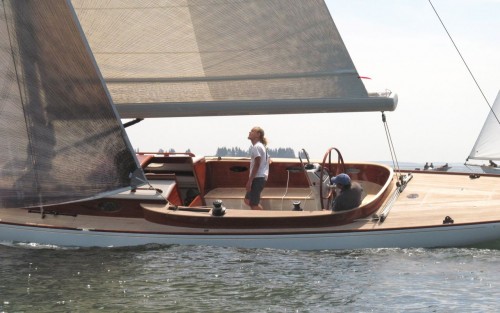
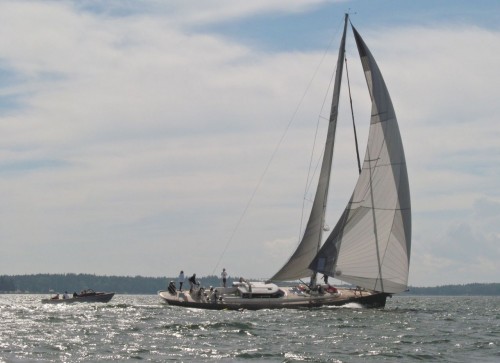
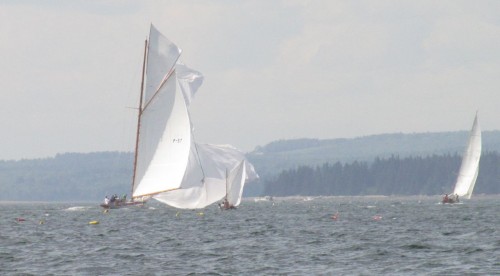
The day of the Eggemoggin Reach Regatta began with no wind and rain. Fetch couldn’t part take because one has to be at least 26′. About 100 classic wooden boats gathered for the start and I tried to stay out of the way with Fetch, but at some point I accidentally drifted over the start line; oops. The first classes started with a fair amount of wind, but by the time the bigger faster boats went over the line the wind had pretty much died. Millions of dollars worth of boats were just drifting about. Gradually the sea breeze came up and finally built to about 18 knots. By now the boats were really going. Just in front of me a beautiful big yacht, carrying a huge spinnaker, was heeling so much I thought it was going to put the mast in the water. Suddenly the boat just popped up after the spinnaker blew right in half.


skippers meeting


smallest boat meets biggest boat


big old gaffer running the start line


spinnaker blows in half


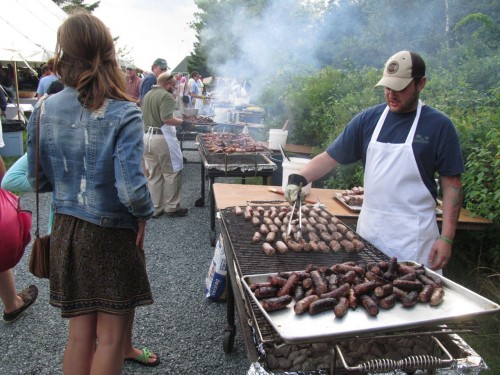
After the regatta hundreds of sailors gathered on the lawn at the waterfront for a BBQ and award ceremony. The day ended with an amazing sunset flooding a whole fleet of anchored classic boats in golden light. What a day!


BBQ afterwards


what a day!

08 Aug

1 Comment

Fetch: Visit to Port Townsend

by

After the students graduated at the Great Lakes Boat Building School in June I headed south to park my van and Fetch, so I could fly to Port Townsend. Originally I was just going for 10 days or so and parked my rig at James Day in Grand Rapids. While in PT, I had so much fun that I decided to stay a bit longer. Andy’s dad, Frank James, was so kind to drive my rig over to his house where long-term parking was more suitable.

It was good to get back to PT for a while, seeing my family and friends and all the familiar places to hang out. One of the reasons I came to PT was to help out Ed Louchard with a fabulous boat project. He was in the final stages of a thorough restoration (or replica?) of Vapor, one of the last remaining go-fast steam launches of this kind, built by the Herreshoff Boatyard. The boat was about 30’ long, fairly narrow with 6’ beam and capable of going 16 knots. The big steam engine was in LA, with the owner of the boat. It had been in Ed’s shop for years and Ed had asked me to help getting it done. Ed and his lovely family live out in the woods just outside PT and it was a treat to go there every day and work with Ed, William and Fish.


Port Townsend


Vapor in final stages


The foredeck I worked on


Ed’s shop


Ed makes custom sheaves as well


William was always smiling


Fish


a Barred Owl in Ed’s drive way.


In evenings and weekends I could hang out with my family and friends. My sons Theo and Nico joined me on a hike up Mount Townsend, just south of PT. We left early and got to the top around midday, before it started getting cloudy and rainy. Going down was a lot faster, but my muscles were quite sore the next few days.


Nico, Theo, Sofia and yours truly


on top of Mount Townsend


brothers


Right when I was in town, a sailboat (19’ Concordia Sloop) I had worked on in the Maritime Center was launched for the first time. I had a chance to help bend the sails on it and take her for a sail. Paul Siefried, the owner, had started this project 15 years ago. Paul is a renowned violin bow maker in town. He first lofted her and built the backbone. To learn how to do lapstrake planking he took a class at the Northwest Boatbuilding School in PT. He was the only student who had signed up, so they invited him to bring his boat over and plank it at the school. He worked hard for a few weeks till his body couldn’t do it anymore and got all the planks on. The boat then sat in his shop for 6 years waiting for more time. When I had just started being the boat shop educator at the brand-new Northwest Maritime Center, Paul and I decided to put the boat in the center to get finished. We worked on her for a few years off and on with help of Jason, Dave, Mike, Maud, Chuck and others to finish her out with frames, floors, decks, seats and spars. After my job ended there, I finished the rig and hardware. Sails were made by Northwest Sails and finally the boat was ready. It was a delight to sail her and Paul was happy.


First sail of Paul’s boat


Sean Rankin’s spitsgatter


Eileen R. freshly restored in the Maritime Center


A few months ago I was reading a book about a couple rowing from the Seattle area to Alaska and my mind started churning. What if I did something like that; it would be good for my health and an adventure at the same time. A lot of people have actually done that in either rowboats or kayaks. To Ketchikan is about 800 miles, which can take between one and two months of traveling. I called Ron Mueller in Bellingham, who designs rowboats. I knew him from doing raids (week long trips with small row and sail boats). He had designed some capable boats and mentioned there was one in PT, that had done that trip to Alaska. I went to see Ron at his house and he showed me his new design, the Salish Skiff, which was a delight to row. I also talked to Dale McKinnon, who lives in Bellingham as well and looked at her boat, designed by Sam Devlin. About 8 years ago she rowed that trip solo. I then drove to Port Angeles to see Chris Duff, who attempted to row from Scotland to Iceland! Twice he got stuck partway because of weather conditions. First he and his wife are going to kayak down the outside of Vancouver Island (no small feat by itself) and when the weather near Iceland is favorable, he’ll attempt the crossing to Iceland again. In PT I met Sue and Richard who have a Mueller designed double that Richard built. Sue rowed that trip in a similar boat with Robin years back. They were kind enough to let me try out their boat. My friend Marcelle and I took the boat out several times and had a blast. I don’t know yet whether I’ll row that trip single or with somebody, but a seed was planted.


Ron Mueller in his Salish Skiff


Dale McKinnon and her Dory


Chris Duff and his wife


Sue and Richard and their Merry Sea, which we borrowed


Marcelle ready to go!


Brief visit to Rat Island


At the end of my stay in PT I was in for another treat, the Pocket Yachters Palooza; a gathering of all kinds of small craft and their owners. Well represented were the Scamps, one of which was the first fiberglass one built by Gig Harbor Boat Works. They did a nice job. While working in the Maritime Center I had quite a bit to do with the development of Scamp’s wooden prototype and it was great to see her getting so popular.


Lots of Scamps in a row


Pocket Yachters Palooza at the Maritime Center


James McMullen, who sold me the Fulmar that became Fetch.


It was time to leave Port Townsend again. I flew back to Grand Rapids where Frank picked me up (bless his heart). I stayed the night at Frank and Judy and the next day I was off. Mind you, I hadn’t travelled in my van for over 10 months now, so it took a while to get used to things again. I stopped at Niagara Falls, where I was in awe and got wet standing right under one of the falls. Then east along Lake Ontario to Clayton NY and the Thousand Islands. Bud from the Great Lakes Boat Building School had recommended I visit the Antique Boat Museum and meet Mike Corrigan, who runs the boat shop. The museum is a very impressive facility with lots of beautiful classic boats. Power boats as well as canoes, Adirondack boats, Lawrence skiffs. Mike showed me the place and a large storage building full of lots more classic boats. I had a ride in one of the Hacker speedboats getting a sense of the islands. I also took out one of the gorgeous Lawrence River Skiffs.


Niagara Falls


Antique Boat Museum in Clayton NY


Nice facility


Mike Corrigan, the boat shop manager


Mike is building a replica of a Lawrence River Skiff in the boat shop


famous race boats


Adirondack Guide Boat


the Lawrence River Skiff that I rowed


I then launched Fetch and sailed two days in the Islands. I crossed the border to go in Canadian water and spend the night in pouring rain. I woke up with about 50 Canadian Geese (no kidding) around me and a snake swam around Fetch to get ashore. Early evening I had a great sail in a nice breeze around the west end of Grindstone Island and arrived back in Clayton late evening, just in time to load up before dark.


sailing Fetch with rain coming


sailing around Grindstone Island


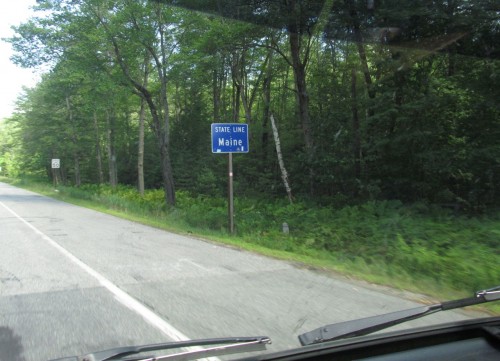
I drove through the Adirondack Mountains and just before Lake Champlain, I saw a town called Keeseville and I just had to go there to take a picture. I crossed the Lake on a ferry and drove through Vermont and New Hampshire to Maine and went straight for the WoodenBoat School.


What do you know!

26 Jul

0 Comments

Little Glass Scamps

by

We received a neat gift from some good friends last week—several stained glass Scamp ornaments. The hand-crafted replicas came in assorted colors and each features a curved sail. Apparently the artisan builders—Don and Kathy Hardy of Ships of Glass, use old beer bottles and such for the curved glass. My friend says he offered them an almost endless supply of empty beer bottles from his personal collection in trade, but they politely declined. Fortunately these little gems are surprisingly inexpensive. —Eds

Filed Under: Uncategorized

18 Jul

5 Comments

Fetch; Great Lakes Boat Building School part 3.

by

Spending a winter in Upper Michigan (the UP) is an interesting experience. Having grown up in the Netherlands, I’ve been through some cold winters, but nothing like this. Two feet of ice on the channels around the school and temperatures down to -23F (-30 C). I did spend a winter month in Finland once and that was very similar. No wonder a lot of Fins and Norwegians moved here in the past. People enjoy the winters here though; often dry sunny weather, hunting, ice fishing, cross country skiing, snow mobiles and snow shoeing, besides of course throwing another log in the wood stove.

cross country skiing along Lake Huron


students Chris, Selina and Andy


bizarre ice craters along the lake


ice shanties


holes in the ice inside the shanty


kids snow mobile racing


my van waiting for warmer weather.


At school we were working hard on the various boats. In total we started 6 boats and finished 4 of them. I’ll show the different projects one by one.


The whaleboat proved to be somewhat of a challenge, specially the frames. Typically frames are bend ‘on the flat’, meaning with the wide side touching the hull. These frames however, were bend ‘on edge’. They were ¾” wide and 1 ¾” deep and required a specially build trap mold to bend them. This way they initially had all the same curve and after taking them off the mold, had to be modified to fit the various areas of the hull. They also had to be notched around the battens and laps of the hull. Finally, using real green straight-grained oak and not leaving them on the mold too long we managed to fit all frames. The boat seemed to be designed to be very strong for it’s weight. Many parts were to follow, centerboard trunk, ceiling (boards on inside of frames), thwarts, knees, heavy gunnels etc. The oars and spars were build elsewhere. After launching it proved to row very nicely and be absolutely gorgeous. We could barely imagine how hard it would be to row this boat, heavily loaded with gear on an open ocean chasing a whale, let alone harpooning it and then be yanked though the water at high speed! Often they would sail up to the whale to be quieter, and then quickly strike the sail and mast, which weren’t small or light. I guess the boats were made of wood and the men of iron. In June, after graduation, the boat would be driven to Mystic Seaport for the boat show and be left there to go with the Charles W. Morgan, the last whaling ship in the US that’s been restored over the last couple of years and to be relaunced in July.


installing frames in the whaleboat


frames are notched around battens and laps.


special trap mold for bending frames


painting the interior


installation of ceiling boards


photo for WoodenBoat Magazine ad.


proud builders


first row!


The Rescue Minor, built by the second year students, made steady progress and was finished on schedule. All the plywood was twice coated in epoxy, then primed in a two-part primer and painted with a one-part marine enamel. The floor boards and gunnel were Iroko, left bare it will turn grey like teak does. The owner already had purchased an electric motor which was about 6 hp equivalent. We installed 4 heavy gel-mat batteries with a total weight of 660 lbs to give the boat a reasonable range and speed (about 6 knots). Everything was nicely concealed under the console, which hinged up for access. The motor was housed under a removable box. Personally I think it’s hard to beat a combustion engine when it comes to cost, weight, range and speed. Can’t wait to see a small energy cell of a few pounds that’s affordable and will go all day with lots of power…. keep dreaming.


tunnel drive.


ready to be turned over.


deck framing


batteries and controls neatly arranged under hinged console.


ready for the water


the builders enjoying the ride.


The little lapstrake Chica of about 7’ by 4’ came out nice. We decided to go ahead and build a strip-planked version of it as well. This was an introduction for the first year students to contemporary construction. We considered it a tender to a cruising yacht and gave it buoyancy tanks with access hatches. A fore and aft seat would allow shifting the rower’s weight to allow for a passenger and load. The sheer was made of red cedar and would be left bright, while the rest of the hull was made of clear white cedar to be painted. The whole hull was glassed in and out and got 4 frames for stiffness, because there was not going to be a thwart. The inwales got spacer blocks for strength and a few light cedar floorboards to finish it off.


first strips are going on.


last strips


smooth, strong and light.


air tanks and frames


spacer blocks for the inwale


The Chippewa went through periods of various appreciation. The lofting and planking were challenging, while all this time we suspected the free board to be too low. We resisted changing it though and once on the water it proved to be just gorgeous and row very well indeed. I could row it at a consistent 4 knots, it left little wake and just slit through the water. This boat is a local design and many were build right there in Cedarville. A local model builder, Paul Wilson, had built several versions of it and showed us his collection one day.


fresh off the molds


bending frames


frames looking aft


painting party!


she rows like a charm.


Chica (on the left) and Chippewa


Paul Wilson showing his beautiful models


After winter break we had started building Katie, a 20’ gaffer, designed by Harry Brian. This boat gave the students practice with a backbone with deadwood, ballast, floors and carvel planking. Next year decks and a cabin will be added. After setting up the backbone with the molds we worked on floors for a while. Ribbands formed the steam bent frames, which went real smooth thanks to nice bending oak, cut locally. For planking we used Cypress, which was fairly clear and nice to work with. The hull seems very promising, with it’s proud bow, flat run, and stiff sections. I’m confident that it will be a nice cabin cruiser, with a real shippy feel.  I can well imagine crawling in the cozy cabin after a hard sail, lighting the woodstove, cooking up a simple meal and hunker down for the night.


shaping the transom of Katie


installing ribbands


bending frames


fitting planks


hot out of the steambox


nice lines


We also finished a small launch which was started last year. We installed decks, seats and an old time gas engine. After paint a local sign painter put on gold lettering.


gold lettering on the Lawley Pop


A great advantage of the teaching schedule is having breaks. With Spring break coming up I got the urge to be around warm weather for a bit. I booked a flight to Puerto Vallarta in Mexico to visit my friends Rob Sanderson and Kai, who spend the winter on a nice cruising sailboat ‘Velella Velella’. They work in Alaska in the summer to fill the cruising kitty and then hang out in Mexico where water and air is warm. Kai was doing a intensive yoga class and Rob was hanging out on the boat, watching whales and surf with his friends. I tried to surf one day, got on a wave a few times before I was exhausted and ended up with sore muscles for a few days. It made me appreciate surfers a lot more; you have to be in pretty good shape to keep at it. Reading and hanging out on the boat and in town suited me just fine. We sailed a few times on the Banderas Bay between Punta Mita and Bucerias, we saw humpbacks whales, dolphins and lots of seabirds. We took a nice day-hike on the south shore and I spend two days in the city by myself. One night on the boat, I woke up hearing cows in the distance. I went outside and didn’t hear it anymore. Back down below I heard it again and realized they weren’t cows but whales! I put my ear right on the hull and could hear it in great detail. There was a lot of back and forth between whales with repeating sounds. Fascinating to lay there listening to these great creatures communicating with each other.


Rob and Kai’s boat, a 38′ Ingrid


cozy interior


sailing to Punta Mita


Rob taking pictures of humpback whales


humbacks


dolphins


dive bombing blue footed boobies


pelicans everywhere


local kids just hanging out


schooner in paradise


dining in the shade with friends


local bead art


going ashore in the dink


going out through the surf


great surfing


a drink afterwards, life is good


one of Rob’s fabulous breakfasts aboard Velella Velella


jungle all around


I’m being watched


small heron waiting for fish


time to say goodbye


Back in Michigan the ice had just broken around Mackinaw Bridge and it wouldn’t be till mid April for the ice to melt in front of the cottage. On May 12th we had our last snow storm. Being still cold outside, I found some time to take on a bit of a dove-tail challenge and put together a crazy complicated box, with curved sides that tapered in thickness. I don’t think I would do that again.


Fetch in last snow storm on May 12!


glueing together the crazy dove-tailed box


pretty though…


As soon as ice and snow were gone, the birds seemed to make haste getting on with building nests and raising their offspring. Swans, Sandhill Cranes, Terns, Swallows, Geese, Ducks, Herons, Bitterns and lots of songbirds all were busy doing their thing. Otters, Beavers and Muskrats finally didn’t have to deal with ice anymore. Deer could swim across the water again without getting stuck in floating ice. Ospreys carried tons of fish to their nests and Bald Eagles would chase them, trying to make them drop their catch. Summer folks would come back up from down-state to occupy their waterfront cottages and scoot around in their Chris-Crafts. It felt a bit like they were cheating not being there for the cold winters.


Mid May Andy and visited ‘Windswept’; Bonnie and Tim’s summer camp on one of the islands. Bonnie’s family ties to this area go way back and she was one of the initiators of the boat building school. Andy kayaked and I rowed the Chippewa. We had wonderful time hanging in front of the fireplace enjoying good food and great company.


underway to Windswept


Windswept consists of four cottages among trees along the lake edge


yum!


heated with a fire place


the boathouse


Chippewa tied up


…seemingly floating in air


visit of a Beaver


Early June the students graduated and left for home or to their new jobs. For me, I loaded up Fetch, hooked her behind my van and hit the road. Instead of going east however, I would first spend some time out west in Port Townsend, but more about that later.